怭
Character Story & Explanation
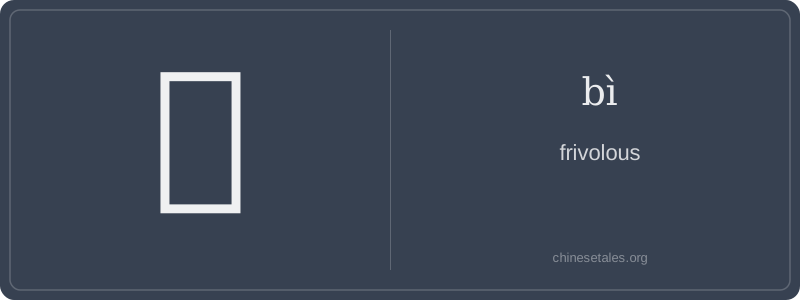
The earliest form of 怭 appears in bronze inscriptions as a composite glyph: the left side was originally 示 (shì, 'altar' or 'ritual'), later simplified to 礻 (the 'spirit' radical), while the right side evolved from 畀 (bì, 'to bestow'), which itself derived from a pictograph of hands offering grain at an altar. Over centuries, the grain and hand elements stylized into the current 畀 — three horizontal strokes atop a 'staircase-like' 田 shape — giving 怭 its distinctive asymmetry. By the Han dynasty, the character had stabilized into its present form: 礻 + 畀, visually balancing reverence (altar) with action (bestowal), yet ironically signaling their imbalance.
This visual tension mirrors its semantic evolution: in the Shuōwén Jiězì (121 CE), Xu Shen defines 怭 as 'light and unsolemn' — a moral judgment arising precisely because the act of 'bestowing' (畀) at a sacred altar (示) should be solemn, yet here it’s depicted as casual, even careless. The Book of Songs uses 怭 in 'bì bì' to describe courtiers whose laughter undermines ritual decorum. So the character doesn’t depict frivolity directly — it shows sacred action done *without* gravity, making its critique profoundly cultural, not just behavioral.
At first glance, 怭 (bì) feels like a linguistic ghost — it’s real, attested in classical texts like the Shuōwén Jiězì, yet utterly absent from modern spoken Chinese and even the HSK. Its meaning 'frivolous' isn’t just about silliness; it conveys a morally loaded lightness — someone who lacks solemnity, gravitas, or ritual propriety (lǐ 礼). In ancient Confucian thought, this wasn’t mere playfulness but a subtle breach of social harmony: think of a courtier giggling during ancestral rites, or a scholar skipping brushwork discipline for flashy calligraphy.
Grammatically, 怭 is almost exclusively literary and adjectival, nearly always paired with other characters to form compound words (like 怭怭 or 怭佻), never used alone in speech. You’ll never hear 'tā hěn bì' — instead, you’ll find it in phrases like 'bì tāo' describing reckless, ungrounded behavior. Learners sometimes misread it as 'bǐ' (like 比) due to the 'bì' sound, or confuse its structure with 必 (bì, 'must') — but 怭 has no functional role in modern grammar, making it a pure historical artifact.
Culturally, 怭 reveals how deeply Chinese ethics were woven into language: a single character could encode disapproval of insufficient reverence. Modern learners often overestimate its relevance — it’s not 'advanced vocabulary' but rather a fossil word, like 'thou' in English. The real lesson? Not every character in the dictionary is alive — some are respectfully preserved in dictionaries like museum specimens, whispering about values we’ve moved past.