忛
Character Story & Explanation
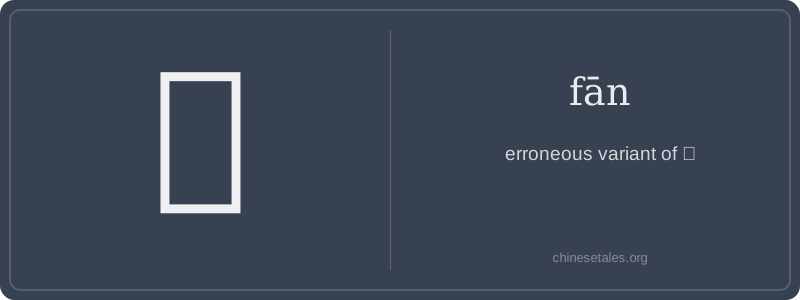
The original oracle bone and bronze inscriptions for 'sail' didn’t depict 忛 — because 忛 didn’t exist back then. The true ancestor is 帆, first attested in Han dynasty bamboo slips: a clear combination of 巾 (cloth) on the left — evoking the woven fabric of sails — and 凡 (fán) on the right, serving phonetically. Over time, hurried clerks began simplifying the left side: 巾’s three vertical strokes sometimes blurred into the wavy, hair-like 彡 (shān), especially in cursive script where speed trumped precision. That visual slippage — cloth becoming fringe — created the rogue form 忛, which appeared sporadically in Ming-Qing vernacular novels and Qing-era manuscript glossaries as a handwritten variant, never standardized.
This wasn’t semantic evolution — it was orthographic drift. While 帆 retained its nautical meaning across dynasties (e.g., in Du Fu’s line '风急天高猿啸哀,渚清沙白鸟飞回。无边落木萧萧下,不尽长江滚滚来。万里悲秋常作客,百年多病独登台。艰难苦恨繁霜鬓,潦倒新停浊酒杯。' — though he never used 忛), 忛 carried no literary weight. It never entered rhyme dictionaries like the Guǎngyùn, nor did it appear in Kangxi’s monumental dictionary. Its survival is purely typographic archaeology: a fossilized typo, preserved only because pre-modern printing presses occasionally replicated scribes’ errors — and later, digital encoders archived them 'just in case.'
Here’s the truth no textbook will tell you: 忛 doesn’t really exist — at least, not as a legitimate character in modern Chinese. It’s a ghost in the script: an erroneous variant of 帆 (fān, 'sail'), born from centuries of scribal slip-ups and regional handwriting quirks. Visually, it swaps 帆’s left-side radical 巾 (jīn, 'cloth') for 彡 (shān, 'ornamental strokes'), turning a functional nautical symbol into something that looks like a sail bedazzled with fringe — charming, but wrong. In practice, 忛 appears only in old manuscripts, misprinted dictionaries, or as a typo in digital texts; it carries zero grammatical weight and cannot stand alone as a word, morpheme, or even a valid component in compound formation.
Learners rarely encounter 忛 in speech or writing — and that’s intentional. It has no pinyin entry in the Xiàndài Hànyǔ Cídiǎn, no place in the GB2312 or Unicode CJK Unified Ideographs block (it’s relegated to the ‘CJK Compatibility Ideographs’ zone, code point U+FA0B — a digital attic for obsolete forms). If you see it in the wild, it’s almost certainly a mistake: someone mistook the cloth radical for decorative strokes, or a font rendered 帆 poorly. Using 忛 in formal writing is like signing your name with a flourish that changes your surname — technically legible, but socially awkward and technically incorrect.
Culturally, 忛 is a quiet lesson in how Chinese orthography polices itself: characters aren’t just sounds or meanings — they’re contracts between writer and reader, enforced by centuries of lexicographers, printers, and now, input-method algorithms. The fact that 忛 survived *at all* is thanks to historical inertia, not utility. So if you spot it? Tip your hat to the scribe who made the error — then rewrite it as 帆. No shame in the slip; just correction with care.