徽
Character Story & Explanation
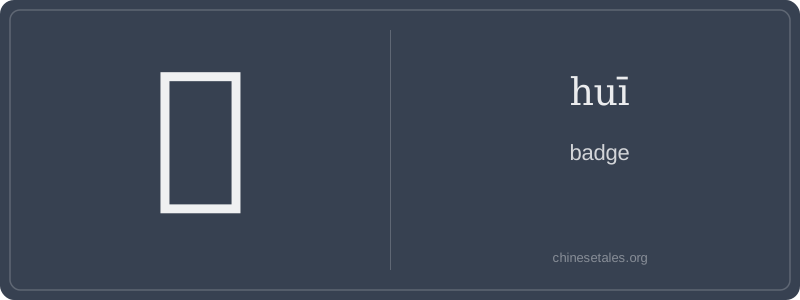
The earliest form of 徽 appears in Warring States bamboo texts and Han dynasty seals — not as a pictograph of a badge, but as a complex ideograph combining 彳 (chì, 'to walk' — suggesting movement, journey, or official conduct), 屮 (chè, 'sprouting grass' — symbolizing growth and auspiciousness), and 黑 (hēi, 'black') plus 殿 (diàn, archaic variant meaning 'hall' or 'structure'). Over centuries, these elements condensed: the top became 彐 (jì, a simplified 'roof/hall'), the middle fused 屮 + 黑 into the modern upper-right structure, and the left radical 彳 remained to anchor its association with human action and official identity.
This evolution mirrors its semantic journey: from early meanings like 'auspicious sign seen on a journey' (in divination texts) to 'distinguishing emblem of a state or clan' (in the *Zuo Zhuan*), then solidifying during the Ming and Qing dynasties as the standard term for institutional emblems. Crucially, its visual complexity — 17 strokes, with dense black-in-the-middle energy — reflects how seriously Chinese culture treats symbolic authority: you don’t slap a 徽 together; you carve, cast, or embroider it with intention.
At its heart, 徽 (huī) is about *identity made visible* — a mark that declares 'this belongs to X' or 'X stands for Y.' Think of it less as a generic 'badge' and more as a *symbolic seal*: the red emblem on a diplomat’s lapel, the embroidered crest on a martial arts master’s robe, or the ancient clan insignia carved into bronze ritual vessels. Its core feeling is solemnity, legitimacy, and belonging — never casual or decorative.
Grammatically, 徽 is almost always a noun and rarely stands alone; it appears in compound nouns like 校徽 (xiào huī, school badge) or 国徽 (guó huī, national emblem). You’ll almost never say 'I wear a 徽' — instead, you’d say 'I wear my school’s 徽' or 'This is the university’s 徽.' Learners often mistakenly treat it like 英文中的 'badge' — trying to use it with verbs like 'wear' or 'design' directly — but it resists that. It’s a *title-bearing symbol*, not an object you handle lightly.
Culturally, 徽 carries weight: it’s tied to authority, heritage, and collective identity. The national emblem (国徽) isn’t just art — it’s constitutional symbolism. Misusing it (e.g., printing it on coffee cups) can raise eyebrows or worse. Also, don’t confuse it with 章 (zhāng), which means 'seal' or 'medal' and implies personal achievement — 徽 is about group affiliation, not individual merit.