彝
Character Story & Explanation
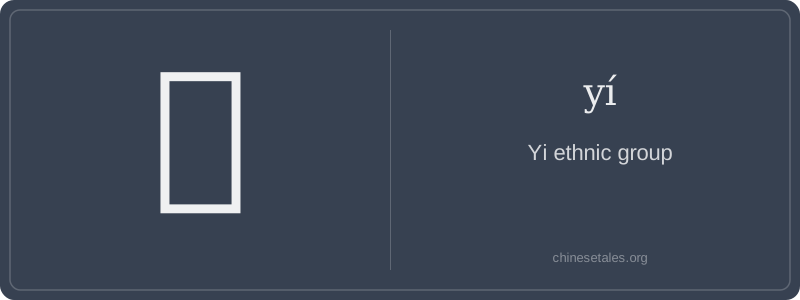
The earliest form of 彝 appears on late Shang bronze inscriptions as a complex pictograph: a tripod cauldron (like a dǐng 鼎) topped with a hand holding a bird (or feathered headdress), flanked by two ritual wine vessels (yǒu 又 + possibly a stylized ‘cup’). Over centuries, the cauldron morphed into the upper 彑 (a radical meaning ‘pig head’ but here acting as a phonetic-semantic fusion), while the lower part solidified into 米 (rice) and 纟 (silk thread), symbolizing ritual abundance and sacred textiles used in Yi ancestor worship. By the Han dynasty, the character had stabilized into its modern 18-stroke structure — still echoing ceremonial vessels and offerings.
This ancient ritual vessel origin explains why 彝 came to signify ‘standard’, ‘ceremonial norm’, or ‘sacred pattern’ in classical texts like the Book of Rites (礼记), where ‘yí’ meant ‘ritual protocol’. Only during the Ming-Qing transition did the term shift specifically to denote the southwestern Yi people — likely because their traditional bronze drums, sacrificial rites, and written scriptures were perceived by imperial scribes as embodying the ‘classical ritual standard’ (彝) itself. The character thus carries a double legacy: ancient liturgical precision and enduring ethnic sovereignty.
Think of 彝 like the word 'Celt' in English — not just a name for a people, but a cultural anchor carrying millennia of ritual, language, and identity. In Chinese, 彝 exclusively refers to the Yi ethnic group (one of China’s 56 officially recognized minorities), and it carries deep sociolinguistic weight: you’d never use it casually or as a standalone noun without context — it’s almost always paired, like ‘Yi nationality’ (彝族) or ‘Yi script’ (彝文). Unlike generic terms like ‘ethnic group’ (民族), 彝 is a proper noun with capital-letter gravity — drop it into a sentence without the right modifier, and native speakers will pause, waiting for the rest of the phrase.
Grammatically, 彝 functions only as a prefix or attributive noun — never as a verb, adjective, or independent subject. You’ll see it in compounds like 彝语 (Yí yǔ, ‘Yi language’) or 彝历 (Yí lì, ‘Yi calendar’), but never alone in speech or writing. Learners sometimes mistakenly treat it like a common noun and say *‘wǒ shì yí’* (I am Yi) — but that’s unnatural; the correct phrasing is *‘wǒ shì Yízú rén’* (I am a Yi person). It’s a lexical ‘title’, not a descriptor.
Culturally, 彝 evokes highland Sichuan, Yunnan, and Guizhou — where the Yi have preserved one of China’s few living indigenous logographic scripts (the Yi script, standardized in 1980). Mispronouncing it as ‘yǐ’ (third tone) instead of ‘yí’ (second tone) can cause confusion — the latter is the sole accepted pronunciation for the ethnic group, while ‘yǐ’ appears in homophones like 已 (already). Also, never confuse it with the archaic literary character 彞 (a variant form now obsolete in mainland usage).