弇
Character Story & Explanation
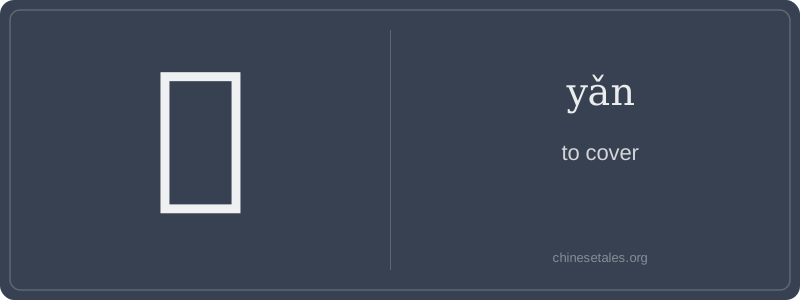
The earliest form of 弇 appears in bronze inscriptions as a pictograph combining 廾 (two hands raised in offering) above 亼 (a variant of 人 rén, 'person', stylized as a roof-like shape). Together, they depicted hands gently lowering a canopy or veil over a person — visualizing ceremonial covering, perhaps during rites of investiture or burial. Over centuries, 亼 evolved into the top component resembling ‘宀’ (roof radical), while the lower 廾 retained its two-hand structure — hence the modern 9-stroke form: 宀 + 廾, where the 'roof' symbolizes what is being covered, and the 'hands' perform the act.
This visual logic held firm across dynasties: in the Shuōwén Jiězì (121 CE), Xu Shen defined 弇 as 'to cover; to conceal', citing its use in Zhou dynasty ritual texts describing how ancestral tablets were 'covered with embroidered silk' (以繡黼弇之). Later, in Tang poetry, 弇 acquired metaphorical weight — Du Fu used 弇蔽 to describe how political corruption veiled moral clarity. Crucially, the character never shifted to mean 'to hide away'; its hands-on, deliberate, almost reverent connotation remained anchored in its dual-component anatomy.
Think of 弇 (yǎn) as the Chinese equivalent of a stagehand pulling a velvet curtain — not flashy, but essential for concealment and transition. Its core meaning 'to cover' isn’t about brute force (like 盖 gài) or permanent enclosure (like 封 fēng), but a deliberate, often ritualistic or poetic act of veiling — like draping silk over an altar, shielding light with a hand, or obscuring truth with elegance. It carries quiet authority: you don’t *force* coverage; you *enact* it with intention.
Grammatically, 弇 is almost never used alone in modern speech — it’s a literary verb that appears mainly in classical compounds or fixed expressions (e.g., 弇蔽 yǎn bì 'to obscure'). You won’t say 'I covered the book with cloth' using 弇; instead, you’d encounter it in writing like 'the mist 弇住了远山' (the mist veiled the distant mountains). It’s transitive and formal — no colloquial contractions, no aspect particles like 了 or 过 unless embedded in classical syntax.
Culturally, learners often misread 弇 as 'to hide' (藏 cáng) or 'to close' (关 guān), but it’s more nuanced: it implies aesthetic or moral concealment — not secrecy, but reverence, modesty, or poetic indirection. A common mistake is overusing it in spoken contexts; native speakers reserve it for essays, poetry, or historical narration. Also, its radical 廾 (gǒng) — two hands raised — hints at ritual gesture, not physical action: this is covering *with hands*, not with objects.