厩
Character Story & Explanation
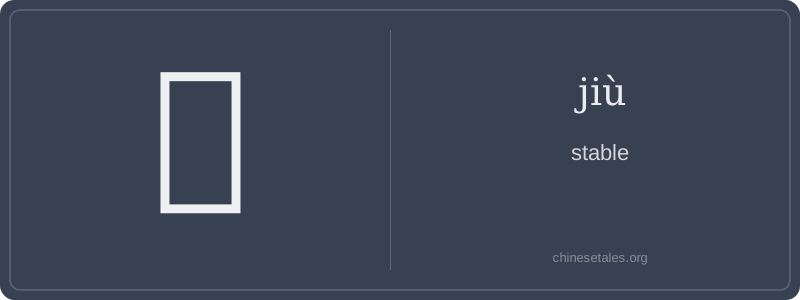
The earliest form of 厩 appears in bronze inscriptions of the Western Zhou (c. 1046–771 BCE) as a vivid pictograph: a roofed enclosure (厂) with two horses (two simplified '马' shapes) inside, sometimes flanked by posts or walls. Over time, the horses morphed into the phonetic component 既 (jì), which now sits beneath the radical 厂 — not because it means 'already', but because its Old Chinese pronunciation (*kʷrəts) approximated the word for 'stable'. The top 厂 (originally a cliff or overhanging rock) evolved to signify a sheltered, covered space — a semantic anchor that survives in characters like 厨 (chú, kitchen) and 压 (yā, to press down).
By the Warring States period, 厩 was already institutionalized: the *Zuo Zhuan* mentions '三厩' (sān jiù, three stables) under state management, each assigned to different royal duties — war, ceremony, and transport. Its visual logic remains satisfyingly literal: 厂 (roofed shelter) + 既 (phonetic, but visually echoing 'two horses under one roof' via its two 'mouth'-like components 口口). Even today, scholars note how the eleven strokes trace the silhouette of an enclosed, hierarchical space — where horses weren’t just kept, but curated.
Think of 厩 (jiù) as China’s ancient equivalent of a high-end equestrian center — not just a barn, but a purpose-built, status-signaling structure for elite horses. Unlike the generic English 'stable', 厩 carries historical weight: it implies official or aristocratic use — think imperial stables in Chang’an, not your neighbor’s backyard shed. In classical texts, it often appears alongside terms like '马' (mǎ, horse) or '监' (jiān, supervisory office), never casually. Modern usage is rare and literary; you’ll almost never hear it in spoken Mandarin — it’s reserved for historical novels, poetic allusions, or formal inscriptions.
Grammatically, 厩 functions strictly as a noun and almost never takes measure words (no *一厩马* — that’s ungrammatical). Instead, you’ll see it in compound nouns (e.g., 马厩) or with classifiers like 座 (zuò): 一座厩. Learners sometimes mistakenly treat it like a verb ('to stable') or try to pluralize it — but it has no verbal form and no plural marker. It’s a fossilized noun: elegant, precise, and stubbornly singular.
Culturally, confusing 厩 with simpler terms like 棚 (péng, shed) or 圈 (quān, pen) misses its aura of bureaucratic order — the Han dynasty even had a 'Jiù Supervisor' (厩令) overseeing imperial mounts. A common mistake? Using it where 马棚 or 马舍 would sound natural and modern. Save 厩 for when you want to evoke the Tang court — not your weekend trail ride.