庹
Character Story & Explanation
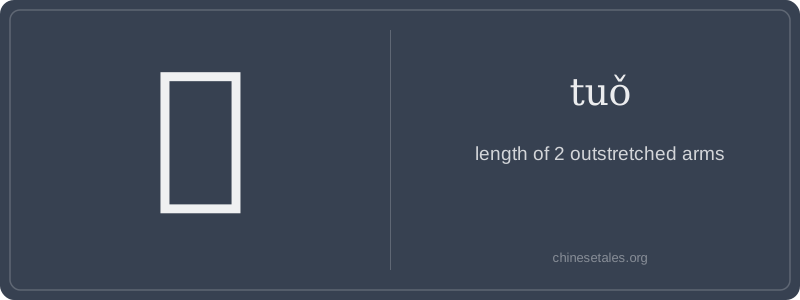
The earliest form of 庹 isn’t found in oracle bones, but its structure tells a clear story: the radical 广 (guǎng, 'broad shelter') frames the right side, while the phonetic component 亠厶大 (a simplified evolution of 大, 'big person') suggests posture. In early clerical script, the character showed a figure with arms extended under a roof-like 广 — visual shorthand for 'the span beneath a broad space'. Over time, the arms became stylized into the top two strokes (丶 and 丿), the torso condensed into 一, and the legs fused into 大 — giving us today’s 11-stroke form: 广 + 亠 + 厶 + 大.
This wasn’t just pictorial — it was functional. In the Shuōwén Jiězì (121 CE), Xu Shen defined 庹 as 'the length of two arms stretched out', linking it to ritual architecture and land surveying in agrarian communities. By the Ming dynasty, carpenters still used 庹 to size roof beams and doorframes — not with rulers, but by stepping and stretching. The character’s shape mirrors its meaning: the expansive 广 radical literally shelters the 'large' (大) human form — a perfect visual metaphor for embodied measurement.
Think of 庹 (tuǒ) as China’s ancient, human-scale tape measure — like the Greek 'cubit' or the British 'fathom', but with arms wide open instead of folded elbows or outstretched hands. It’s not abstract: it’s literally the distance from fingertip to fingertip when you stretch both arms horizontally — roughly 1.6–1.8 meters for an average adult. Unlike modern metric units, 庹 feels bodily and communal: it’s a unit rooted in the human form, passed down orally for centuries before appearing in written records.
Grammatically, 庹 is a measure word (like ‘meter’ or ‘foot’) used *only* with length — never weight, time, or volume — and always follows a numeral or demonstrative: 一庹、这庹、那庹. You’ll almost never see it in isolation; it’s a fossilized unit that appears mainly in folk contexts, historical texts, or regional dialects (e.g., Sichuan or Hunan carpentry). Learners often mistakenly treat it like a verb or noun — but no: it’s strictly a classifier, and never used without a number or determiner.
Culturally, 庹 is a quiet relic of pre-standardization China — a reminder that measurement once lived in the body, not the lab. It’s absent from HSK, textbooks, and daily speech, so encountering it feels like unearthing a linguistic artifact. A common mistake? Confusing it with 厄 (è) or 度 (dù) — both visually similar but utterly unrelated in meaning and usage. If you use 庹 in a Mandarin exam, your teacher might blink twice… then smile wistfully.