庚
Character Story & Explanation
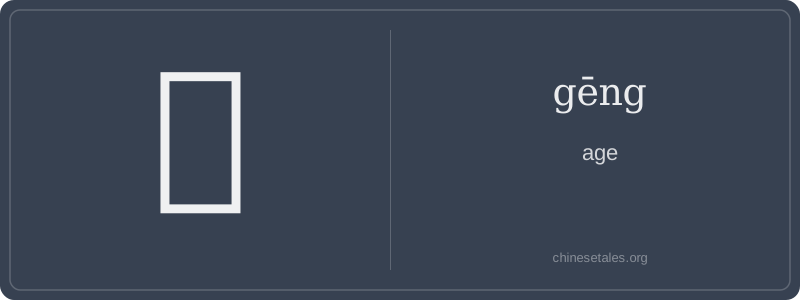
Carved over 3,200 years ago on oracle bones, the earliest form of 庚 looked like a stylized axe or adze — a sharp, double-bladed tool with a pronounced handle and blade tip. Scholars believe this represented *gēng*, an ancient word for a cutting instrument symbolizing 'change,' 'cutting through,' or 'renewal.' Over time, the pictograph simplified: the blade became the top horizontal stroke and diagonal hook (), the handle evolved into the vertical stroke with a small rightward flick, and the base merged into the broad 广 (yǎn) radical — originally a shelter or canopy, here repurposed as a structural frame rather than a semantic clue.
This evolution reflects a profound semantic shift: from a physical tool → to a concept of 'cutting through time' → to the seventh of the Ten Heavenly Stems, governing metal, autumn, and the west. In the Shūjīng (Book of Documents), 庚 appears in calendrical records, and by the Han dynasty, it was fully integrated into astrological and bureaucratic systems. Its shape — angular, decisive, with a strong downward stroke — visually echoes its association with metal’s rigidity and autumn’s crisp transition, making form and meaning inseparable.
Don’t be fooled by the English gloss 'age' — 庚 (gēng) is almost never used alone to mean 'how old someone is.' Instead, it’s a quiet powerhouse embedded in China’s ancient timekeeping system: the gānzhī (Heavenly Stems and Earthly Branches), a 60-year cyclical calendar used for centuries to mark years, months, days, and even hours. To Chinese speakers, 庚 evokes precision, cosmic rhythm, and historical depth — think of it as the 'G' in a celestial alphabet where each letter carries weight, resonance, and generational memory.
Grammatically, 庚 appears only in fixed compounds or classical/formal contexts — never as a standalone noun like 'age' in English. You’ll see it in year names (e.g., 庚子年 gēngzǐ nián — the Year of the Metal Rat), in poetic references to time ('the 庚 hour' meaning 5–7 p.m.), or in rare literary phrases like 庚辛 (gēngxīn) meaning 'the west' (linked to metal and autumn in Five Phases theory). Learners often mistakenly try to say 'my age is 庚' — but that’s like saying 'my age is G' in English; it makes zero sense without the full stem-branch context.
Culturally, 庚 embodies how Chinese thought traditionally fused astronomy, philosophy, and bureaucracy: your birth year wasn’t just a number — it was a cosmic signature with elemental (metal), directional (west), and seasonal (autumn) associations. Mistaking 庚 for a casual word for 'age' misses its solemn, ritual function — it’s not about counting birthdays, but aligning human life with celestial cycles. Even today, elders consult 庚子, 庚寅, etc., when choosing wedding dates or naming babies — not superstition, but continuity.