帱
Character Story & Explanation
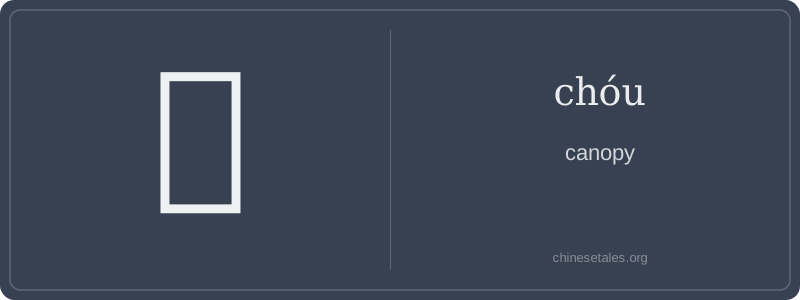
The earliest form of 帱 appears in Warring States bronze inscriptions as a stylized pictograph: a central vertical stroke representing the hanging pole, flanked by two symmetrical, wavy lines suggesting flowing fabric — and crucially, the 巾 (jīn) radical at the bottom, unmistakably marking it as a textile object. Over centuries, the wavy lines simplified into the top component 稠 (chóu), which originally meant ‘thick’ or ‘dense’ — hinting at rich, layered fabric — while the 巾 radical remained firmly anchored, preserving its material identity. By the Han dynasty, the character stabilized into its modern 10-stroke form: two strokes for the ‘thread’ (糹) variant of 稠 on top, then 巾 below.
Meaning-wise, 帱 began as a specific term for the ornamental cloth ceiling over noble beds in Zhou ritual texts, later expanding in poetry to evoke atmosphere — mist veiling mountains was likened to a ‘mountain canopy’ (山綃). In the Classic of Poetry, it appears in descriptions of wedding chambers, where lowering the 帱 signaled the consummation of marriage. Its visual structure — dense fabric (稠) + cloth (巾) — is a perfect semantic compound: thick, suspended textile. Even today, its shape whispers ‘fabric draped high’ — no abstraction, just silk in motion.
Imagine walking into an ancient imperial bedroom in the Forbidden City — not the emperor’s, but a high-ranking consort’s. Above her bed hangs a delicate, embroidered silk canopy: not just decorative, but a symbol of status, privacy, and cosmic order. That’s 帱 (chóu): a canopy, specifically one suspended overhead like a textile roof — soft, protective, and ritually significant. It’s not a tent (帐篷), nor a simple curtain (窗帘); it’s the elegant, draped covering above a bed or throne, evoking refinement and hierarchy.
Grammatically, 帱 is almost always a noun and appears in formal, literary, or historical contexts — never in daily speech or HSK materials. You’ll see it in compounds like 床帳 (chuáng zhàng) or in classical poetry describing palace life. Learners rarely use it alone; instead, it appears as part of set phrases: ‘垂下綃帳’ (chuí xià xiāo zhàng — ‘silk curtains lowered’) or ‘朱綃帳’ (zhū xiāo zhàng — ‘vermilion gauzy canopy’). Don’t try to verb-ify it — it doesn’t take aspect particles (了, 過) or modifiers like 很 — it’s a lexical fossil, preserved in elegance.
Culturally, 帱 carries quiet weight: in Tang and Song poetry, its presence signals intimacy, seclusion, or even erotic suggestion — think of Du Fu’s subtle imagery where a drawn 帱 implies a private moment behind silk. A common mistake? Confusing it with 帳 (zhàng), which is broader (tents, accounts) and far more common. Also, watch the pronunciation: while chóu is standard for ‘canopy’, dào appears only in ultra-rare, archaic phonetic loan usages — ignore it unless reading pre-Qin bamboo texts!