幠
Character Story & Explanation
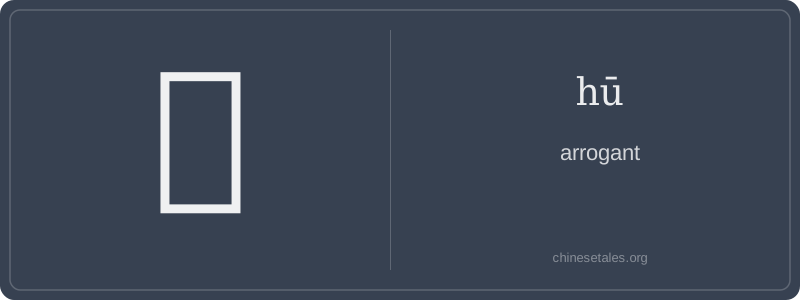
The character 幠 first appeared in bronze inscriptions of the late Zhou dynasty (c. 5th century BCE), where it resembled a stylized figure standing tall with arms akimbo atop a raised platform — not a throne, but a symbolic dais suggesting unwarranted elevation. Over centuries, the platform simplified into the radical 广 (guǎng, 'broad, shelter'), while the upper part evolved from a pictograph of an upright person with exaggerated shoulders (indicating puffing up) into the phonetic component 呼 (hū, 'to shout'), preserving both sound and the idea of loud, attention-grabbing self-assertion.
By the Han dynasty, 幠 had crystallized its moral weight in texts like the Book of Rites (Lǐjì), where it described ministers who 'spoke with 幠 tone' — not merely loud, but defiantly dismissive of hierarchy. Its visual structure reinforces this: the broad shelter (广) frames and contains the 'shouting' (呼) — as if arrogance must be housed, contained, even condemned by social architecture. In classical poetry, 幠 rarely stands alone; it’s always contextualized — paired with words like '失礼' (shīlǐ, 'loss of propriety') or '招祸' (zhāohuò, 'inviting disaster') — underscoring that its danger lies not in feeling superior, but in acting as if the world bows to your ego.
Think of 幠 (hū) as Chinese’s version of the word 'uppity' — not just arrogant, but arrogantly *out of place*, like a peacock strutting through a Zen garden. It carries a sharp, almost archaic judgment: someone who oversteps social or moral boundaries with swaggering self-importance. Unlike common synonyms like 骄傲 (jiāo'ào, 'proud') or 自大 (zìdà, 'conceited'), 幠 implies a kind of performative, ill-timed haughtiness — the kind that invites poetic rebuke, not casual observation.
Grammatically, 幠 is nearly extinct in spoken Mandarin and appears almost exclusively in classical-style writing, idioms, or literary criticism. You won’t hear it in daily conversation — no one says 'He’s so 幠!' — but you might read it in a scholar’s essay condemning a politician’s 'hūrán zìmǎn' (suddenly arrogant demeanor). It functions primarily as an adjective, often modified by degree words like ‘甚’ (shèn, 'extremely') or paired with verbs like ‘显’ (xiǎn, 'to display'): 显幠 (xiǎn hū) — 'to conspicuously flaunt one’s arrogance.'
Culturally, 幠 resonates with Confucian disdain for unearned superiority — it’s less about confidence and more about *disruptive* self-elevation. Learners mistakenly treat it like a modern synonym for 骄傲; that’s like calling 'hubris' interchangeable with 'pride' in English — technically related, but morally and stylistically worlds apart. Using 幠 casually risks sounding either comically archaic or unintentionally Shakespearean.