幋
Character Story & Explanation
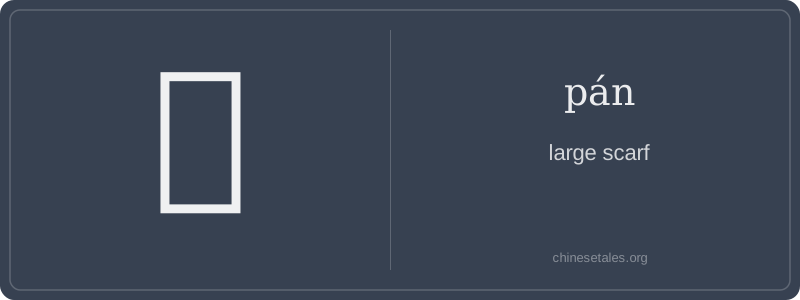
The earliest form of 幋 appears on Han dynasty bamboo slips and late bronze inscriptions — not as a pictograph of fabric, but as a stylized depiction of a long, flowing cloth suspended between two upright posts or pillars, with gentle horizontal undulations suggesting drape and movement. The top part (巾) clearly marks it as textile-related, while the bottom component (般) was originally a phonetic loan — but over centuries, scribes simplified 般’s complex boat-and-hand structure into the streamlined 般 we see today, preserving sound over literal meaning. Stroke by stroke, the character shed its nautical roots and embraced textile grace.
By the Tang dynasty, 幋 had crystallized into a literary term for ceremonial shawls worn by officials and literati — notably referenced in Bai Juyi’s poems describing court attire. Its visual rhythm mirrors its function: the vertical stability of the radical 巾 anchors the composition, while the flowing 般 suggests motion, elegance, and controlled abundance. In Ming-Qing painting inscriptions, 幋 often appears alongside terms like ‘云’ (cloud) and ‘霞’ (rosy clouds), reinforcing its association with ethereal, dignified drapery — not mere clothing, but embodied poise.
Let’s be honest — 幋 (pán) is a quiet character, not the kind you’ll meet in HSK textbooks or daily chat. It means ‘large scarf’ or ‘ceremonial shawl’, and carries an elegant, almost archaic weight. Think less ‘fashion accessory’ and more ‘ritual textile’ — something draped over shoulders during ancestral rites or worn by scholars in Ming-Qing portraiture. Its feel is soft but dignified, never casual: you wouldn’t say ‘I wore my 幋 to the café’ — it belongs to poetry, costume drama, or museum labels.
Grammatically, 幋 functions as a noun only — no verb forms, no measure words attached directly (you’d say 一条幋, not *一幋). Learners sometimes misread it as a variant of 盘 (pán, ‘plate’) due to identical pronunciation, but there’s zero semantic overlap. And crucially: it’s almost never used alone. You’ll nearly always see it inside compounds like 幋巾 or 幋带 — which is why memorizing those phrases matters more than the standalone character.
Culturally, 幋 evokes textile craftsmanship and Confucian decorum: in classical texts, it signals status, restraint, and aesthetic harmony. A common mistake? Assuming it’s interchangeable with 巾 (jīn, ‘towel/scarf’) — but 巾 is humble and functional; 幋 is spacious, formal, and often silk-woven. Also, note its silence in modern speech: you’ll read it far more often than hear it. That’s not obscurity — it’s preservation, like finding a perfectly folded heirloom in an old cedar chest.