巽
Character Story & Explanation
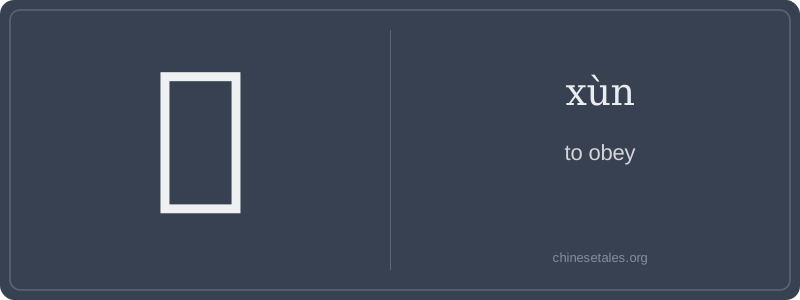
The earliest form of 巽 appears in bronze inscriptions as two symmetrical, downward-curving lines flanking a central vertical stroke — resembling stylized wind-blown reeds or perhaps interlocking banners. Over time, these evolved into the top half's mirrored 丿 and elements, while the bottom solidified into 巳 (sì), the 'Snake' radical — not because snakes obey, but because ancient cosmologists associated the southeast direction (and its gentle, penetrating wind) with the Snake branch of the Earthly Branches. By the Han dynasty, 巽 had stabilized into its current 12-stroke form: a balanced, almost symmetrical glyph suggesting harmony through alignment.
This visual symmetry reflects its philosophical weight: in the Yijing (Book of Changes), 巽 is the 57th hexagram — ☴ — representing wind, penetration, gentleness, and the virtue of following with sincerity. Confucius himself praised 巽 as embodying 'the way of the superior person who enters without force, yet nothing resists him.' Its meaning didn’t shift so much as deepen: from a concrete image of bending wind → symbolic direction (southeast) → abstract moral principle (humble compliance). Even today, when scholars write 巽顺 or 巽命, they’re invoking that 3,000-year-old idea: true authority flows not from command, but from graceful, unresisting alignment.
巽 (xùn) is a quietly powerful character — not flashy like 爱 or common like 是, but deeply rooted in classical Chinese thought. Its core meaning is 'to obey' or 'to yield', but it carries the nuance of humble, willing compliance — not forced submission. Think of a gentle breeze bending grass rather than a storm breaking trees: it’s obedience born of respect and harmony, not fear. In modern usage, 巽 appears almost exclusively in literary, philosophical, or ceremonial contexts — you won’t hear it in daily chats, but you’ll see it in phrases like 巽卦 (the 'Xun' hexagram in the Yijing) or formal expressions of deference.
Grammatically, 巽 functions almost entirely as a noun or adjective, rarely as a verb in contemporary speech. You won’t say 'I xùn you' — instead, it modifies concepts: 巽风 ('Xun wind', the gentle southeast wind), 巽顺 ('obedient and compliant'), or appears in fixed compounds. A classic example is 巽以申命 ('Xun is used to declare commands' — from the Yijing commentary), where 巽 describes the *mode* of authority: soft yet effective, persuasive rather than coercive.
Culturally, 巽 is inseparable from Daoist and Confucian ideals of yielding as strength — think of water wearing down stone. Learners often misread it as 已 (yǐ, 'already') or 巳 (sì, the Snake zodiac sign) due to visual similarity, but 巽 has *twelve strokes*, a distinctive double '8'-like top (two stacked 丿 + shapes), and carries none of the temporal or zodiac meanings. It’s also frequently confused with 逊 (xùn), which *does* mean 'to yield' or 'to be modest' — but 逊 is common, colloquial, and has a 'walk' radical (辶), while 巽 is rare, classical, and anchored in cosmology.