巂
Character Story & Explanation
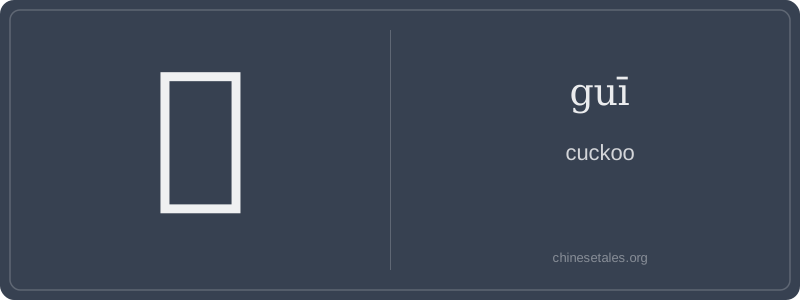
The earliest form of 巂 appears in Warring States bamboo slips as a complex pictograph: at the top, a simplified mountain (山) — reflecting its association with highland habitats; below, a stylized bird (鳥) with extended wings and a distinctive curved beak; and crucially, two parallel horizontal strokes between them, likely representing layered cliffs or echoing the bird’s repetitive call. Over centuries, the bird component shrank and rotated, the mountain radical stabilized at the top, and the middle ‘cliff’ strokes evolved into the two stacked 口-like shapes — not mouths, but graphic echoes of resonance and repetition.
By the Han dynasty, 巂 was already entrenched in classical texts like the *Shuōwén Jiězì*, defined as 'a mountain-dwelling bird whose cry sounds like “guī guī”'. Its use peaked in Tang and Song poetry — Li Bai wrote of '巂声穿松壑' ('the 巂’s cry piercing pine valleys'), linking its voice to solitude and natural grandeur. Interestingly, the character’s visual density (18 strokes!) mirrors how the cuckoo’s call seems to linger and layer in mountain air — a rare case where stroke count aesthetically reinforces meaning.
At first glance, 巂 (guī) feels like a linguistic fossil — it’s not in the HSK, rarely appears in modern speech, and even many native speakers only encounter it in classical poetry or ornithological texts. Yet its meaning is vividly alive: it names the cuckoo bird, specifically the *Cuculus canorus* whose haunting, repetitive call echoes across springtime mountains. Unlike generic terms like 杜鹃 (dùjuān), 巂 carries an archaic, literary weight — think of it as the 'Shakespearean cuckoo': poetic, melancholic, and deeply tied to seasonal change and transience.
Grammatically, 巂 functions almost exclusively as a noun — never a verb or adjective — and almost never appears alone in contemporary usage. You’ll find it embedded in compounds (like 巂州 or 巂山) or in classical allusions, often paired with characters evoking sound (鸣, 啼) or landscape (山, 谷). Learners sometimes misread it as a variant of 归 (guī, 'to return') due to identical pinyin and shared mountain radical, but there’s zero semantic link — confusing them would turn a line about birdsong into nonsense about homecoming.
Culturally, the cuckoo in Chinese tradition isn’t just a bird — it’s a symbol of sorrow, exile, and unfulfilled longing (think of Du Fu’s poems where its cry punctuates desolation). And here’s the twist: while 巂 is pronounced guī in this ornithological sense, it’s also read xī in rare place-name contexts — like the ancient 巂县 (Xī Xiàn) — a pronunciation preserved only in historical geography. This duality reminds us that Chinese characters are living archives: their pronunciations fossilize layers of administrative, linguistic, and ecological history.