嵡
Character Story & Explanation
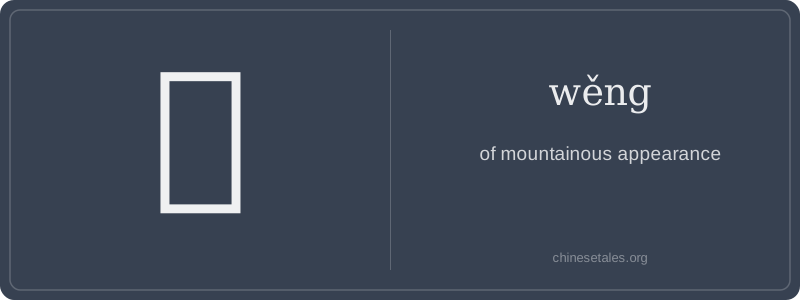
The earliest trace of 嵡 appears not in oracle bones—but in Han dynasty seal script, where it emerges as a deliberate fusion: the mountain radical (山) perched atop the phonetic element 蓊 (wěng), itself derived from 艸 (cǎo, ‘grass/plant’) + 翁 (wēng, ‘old man’—used here purely for sound). Visually, the modern form retains the three-stroke mountain (山) on top, while the lower part evolved from 蓊’s dense, overlapping grass strokes into a compact, cloud-like cluster—evoking vegetation thickening up mountain slopes. No ancient pictograph shows a literal scene; instead, it’s a calligraphic metaphor: ‘mountain + lush growth + resonant sound’.
By the Tang and Song dynasties, 嵡 crystallized in poetry as a descriptor of mist-shrouded, forested peaks—especially in landscape verse by Wang Wei and Fan Chengda. In the *Wen Xuan* (Selections of Refined Literature), it appears in phrases like ‘嵡郁参差’ (wěng yù cēn cī), meaning ‘lush, uneven mountain forms’. Its visual density—those tightly packed lower strokes—mirrors its semantic weight: not just ‘green’, but *profuse, layered, atmospheric green*. Even today, calligraphers linger on its lower half, letting ink bleed slightly to evoke mist rising from wooded ridges.
Think of 嵡 (wěng) as the Chinese language’s poetic whisper about mountains—not the sharp, jagged kind, but the soft, mist-wrapped, deeply ancient ones. It doesn’t mean ‘mountain’ (that’s 山), nor does it describe height or rock—it evokes *atmosphere*: lushness, layered contours, quiet grandeur. It’s almost exclusively used in literary or descriptive compounds—never alone—and always carries a classical, slightly archaic elegance. You’ll rarely hear it in daily speech, but you’ll see it shimmering in poetry, landscape painting captions, or refined travel writing.
Grammatically, 嵡 is an adjective-like morpheme that only appears in fixed two-character words like 嵱嵷 (wěng sǒng) or 嵡郁 (wěng yù). It never takes aspect particles (了, 过), degree adverbs (很, 非常), or comparative suffixes (更, 最)—so don’t try to say *‘very wěng’*. Instead, it pairs with other imagery-rich characters to build compound adjectives: think of it as the ‘-y’ in English words like ‘misty’ or ‘woodsy’—it completes the mood but can’t stand solo. Learners often mistakenly treat it like a standalone word or confuse its tone (third tone, not fourth).
Culturally, 嵡 belongs to the rare class of ‘scenery-tone characters’—characters invented not for utility, but for aesthetic resonance. Its usage signals literary sophistication; sprinkling it into formal writing is like choosing hand-pressed paper for a letter. A common mistake? Pronouncing it as wēng (like 翁) or misreading it as 澎 (péng, ‘surging’) due to the ‘feng’ phonetic component. Remember: this character isn’t about sound or water—it’s about *silence draped in green and fog*.