崳
Character Story & Explanation
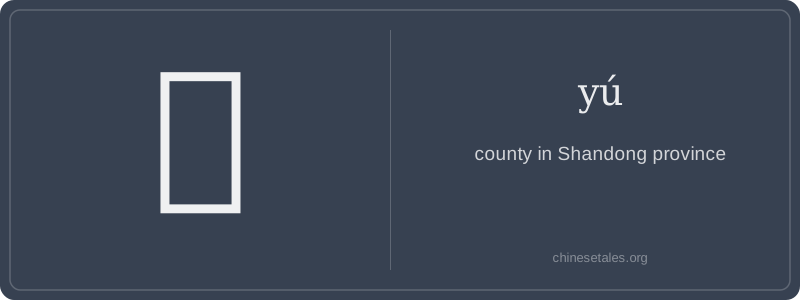
The earliest trace of 崃 appears not in oracle bones, but in late Warring States bronze inscriptions and Qin bamboo slips — a rarity for such a localized name. Visually, it’s a clear compound: the left side is 山 (shān, ‘mountain’), unmistakably drawn with three jagged peaks even in early seal script. The right side, though now stylized beyond recognition, originated as a simplified form of 虞 (yú), an ancient clan name and place associated with legendary Emperor Yao’s minister. Over centuries, scribes streamlined 虞’s complex structure — dropping the ‘tiger’ component (虍) and compressing the remaining elements into two parallel horizontal strokes atop a compact base — until it merged seamlessly with 山 to form today’s 崃.
This fusion wasn’t arbitrary: the region around modern Yú County features low coastal hills and fertile plains where the mythical ‘Yu’ people were said to have settled and farmed. By the Han dynasty, the name was standardized as 崃 in administrative records, cementing its role as a toponymic seal. Unlike characters that evolved semantically (e.g., 明 from ‘sun + moon’ to ‘bright’), 崃 stayed stubbornly geographic — a linguistic monument frozen in bureaucratic ink. Its stability is remarkable: same shape, same sound, same county, for over 2,200 years.
Don’t let the quiet simplicity of 崳 fool you — this character isn’t about mountains, rivers, or philosophy. It’s a proper noun with laser focus: it exists almost exclusively as the name of Yú County (嵎县), a small but historically rich county in eastern Shandong Province, nestled near the Yellow Sea and the ancient Jiaodong Peninsula. In modern Chinese, 崳 carries zero abstract meaning — no verb forms, no adjectival use, no idioms. It’s a geographical anchor, like ‘Oxford’ in English: pronounceable, place-specific, and utterly untransferable. You’ll never say ‘a 崳 feeling’ or ‘to 崳 something’ — it only appears in fixed toponyms.
Grammatically, 崳 behaves like any Chinese place-name character: it rarely stands alone. You’ll see it in compounds like 崃山 (Yú Shān — a mountain range) or 崃县 (Yú Xiàn — the county itself), always paired and always capitalized in spirit — though Chinese has no capital letters, native speakers treat such names with lexical gravity. Learners sometimes overgeneralize and try to use it in metaphors or creative writing, but that’s like using ‘Worcestershire’ as a verb — charming, but linguistically invisible.
Culturally, 崃 carries quiet prestige: it’s tied to the ancient state of Lai (萊), mentioned in the Records of the Grand Historian, and later became a strategic coastal garrison during the Ming dynasty. Mistake alert: don’t confuse its pronunciation yú with yǔ (as in 语) — tone matters! And resist the urge to break it down as ‘mountain + yú’ — while the radical is 山, the right side isn’t the phonetic ‘yú’ you know from 易 or 余. It’s a rare, custom-built phonetic that’s been fossilized for over 2,000 years.