岧
Character Story & Explanation
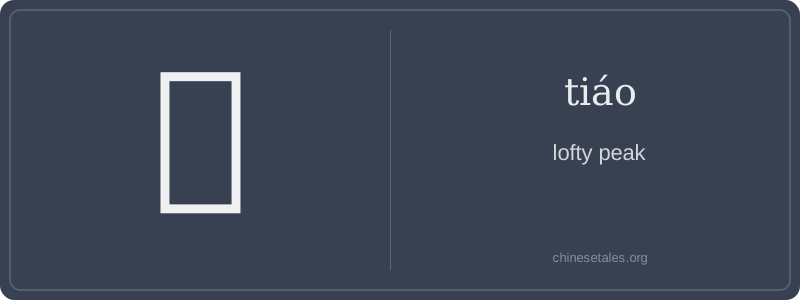
The earliest form of 岧 appears not in oracle bones but in Han dynasty clerical script, built from 山 (shān, mountain) on the left and 兆 (zhào, omen, auspicious sign) on the right. Visually, 山 anchors the meaning in geography, while 兆 — originally depicting cracks in tortoise shells used for divination — lent connotations of prominence, visibility, and cosmic significance. Over centuries, 兆’s three-pronged shape simplified into the modern top-heavy structure, and the whole character tightened into a balanced yet soaring composition — strokes rising sharply like a ridge line against sky.
By the Tang and Song dynasties, 岧 was firmly embedded in poetic diction to describe peaks so high they seemed to commune with heaven — not merely tall, but spiritually elevated. Du Fu once wrote of ‘岧嶤双阙’ (lofty twin towers), borrowing mountain imagery for imperial architecture. The character’s visual asymmetry — the mountain radical low and stable, the 兆 component leaning upward — mirrors its semantic duality: grounded in earth, straining toward the sublime.
岧 (tiáo) is a poetic, almost cinematic character — it doesn’t just mean 'lofty peak'; it evokes the vertiginous hush of a solitary mountain crest piercing cloud cover, as seen in Tang dynasty landscape scrolls or mist-wrapped Song poetry. It’s not a word you’d use in daily chat ('The mountain is tall' → 高, not 岧); instead, it lives in literary descriptions, classical allusions, and compound words like 岧嶤 (tiáo yáo), where its presence instantly elevates the tone to something stately and ancient.
Grammatically, 岧 functions almost exclusively as a morpheme within two-character adjectives (e.g., 岧嶤, 岧屼) — never alone, never as a verb or noun. You won’t say *‘This peak is 岧’*; you’ll say *‘the 岧嶤 peaks’*. Learners often misread it as a standalone adjective like 高, leading to unnatural phrasing. Also, its pronunciation tiáo (second tone) rhymes with ‘tiao’ in ‘tiao liang’ (a type of beam), subtly echoing its architectural sense of height and structure.
Culturally, 岧 carries the quiet authority of classical diction — think of a scholar-poet gazing westward at the Qinling range, writing ‘岧嶤入云’ (lofty peaks pierce the clouds). Mistaking it for a common vocabulary item is a classic ‘over-literary’ error: using it in a WeChat message about hiking would sound like quoting Li Bai while ordering bubble tea. Its rarity outside fixed compounds means it’s best absorbed through context-rich reading — not flashcards.