屦
Character Story & Explanation
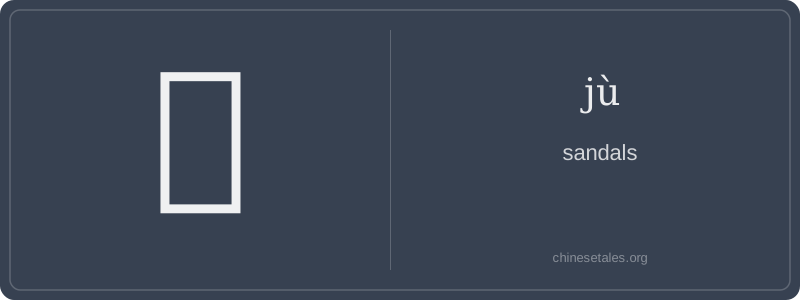
The earliest form of 屦 appears in Warring States bamboo texts as a pictograph showing a bare foot (the bottom part, later evolving into 呂) under a curved, crouching figure (the top 尸 radical). That ‘croucher’ wasn’t a corpse — it was a stylized person bending low to fasten straps around their ankles. Over centuries, the foot simplified into two parallel horizontal strokes (呂), while the upper figure hardened into the 尸 shape we know — still echoing that humble, grounded posture of slipping on sandals barefoot in summer heat.
By the Han dynasty, 屦 was standard in ritual texts and poetry — Mencius praised a ruler who 'wore worn 屦 but fed his people well', turning footwear into moral shorthand. In the Book of Rites, different materials (straw, leather, silk) signaled rank and occasion. Even today, 屦 survives in idioms like 屦贱踊贵 ('sandals cheap, amputation platforms expensive') — a biting satire from the Spring and Autumn period about unjust laws where punishments were so harsh, prosthetic legs cost more than sandals!
Think of 屦 (jù) not as just 'sandals' but as *ancient footwear with attitude* — light, open-toed, woven from grass or hemp, and deeply tied to status and season in pre-Qin China. It’s a literary word, rarely heard in modern speech (you’ll say 拖鞋 or 凉鞋 instead), but it pulses with classical elegance: when you see 屦 in a text, you’re stepping into bamboo slips or silk manuscripts, not a shopping mall.
Grammatically, 屦 is a countable noun that usually appears with measure words like 双 (a pair) or 一 (one), and often pairs with verbs like 穿 (to wear) or 履 (its elegant synonym, also meaning 'to tread'). You won’t say 'I wear jù' in daily talk — but in a poem or historical drama script? Absolutely: '他穿著素麻之屦' (He wore plain hempen sandals) evokes austerity and virtue. Learners sometimes mistakenly use it like 鞋 (xié, general 'shoe'), but 屦 *only* means open, strap-based sandals — no laces, no soles, no sneakers.
Culturally, 屦 was class-coded: coarse hemp 屦 for commoners, fine silk-lined ones for scholars; Confucius himself reportedly wore 屦 made of reeds. A fun trap? Its radical 尸 (shī, 'corpse') has zero relation to death here — it’s a *posture radical*, representing the bent-knee stance of someone putting on sandals! So don’t shudder — smile: this character is literally 'footwear + kneeling person'.