屎
Character Story & Explanation
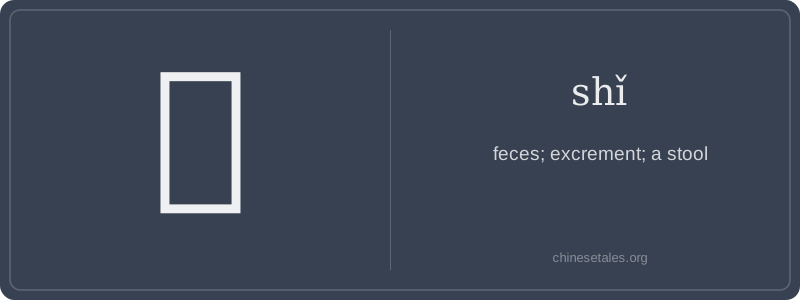
The earliest form of 屎 appears in bronze inscriptions (c. 1000 BCE) as a stylized pictograph: a simplified human figure (尸) squatting over two wavy, irregular lines representing excrement — a remarkably direct, almost comical visual record of bodily function. Over centuries, the ‘squatting person’ radical 尸 hardened into its modern boxy shape, while the lower component evolved from flowing squiggles (the actual fecal matter) into the compact, angular 㐅-like structure we see today — essentially, the character fossilized an ancient bathroom break.
This visceral origin stuck. In the Warring States text Zuo Zhuan, 屎 appears in medical contexts describing digestive disorders, already carrying its blunt physiological meaning. By the Tang dynasty, poets like Bai Juyi used it in satirical verses mocking bureaucratic incompetence — ‘like dung left in the sun’ — cementing its role as a tool of social critique. The character’s enduring power lies in this duality: its visual form screams ‘bodily reality,’ while its usage whispers centuries of wit, shame, and rebellion against pretense.
Let’s get real: 屎 (shǐ) is the unvarnished, no-euphemism Chinese word for feces — raw, biological, and blunt. It’s not polite dinner-table vocabulary, but it’s deeply functional in slang, idioms, and expressive speech. Unlike softer terms like 大便 (dàbiàn) or the clinical 粪便 (fènbiàn), 屎 carries visceral weight — think of it as the linguistic equivalent of a cartoon ‘poop emoji’ with attitude: crude, humorous, sometimes angry, always unapologetic.
Grammatically, 屎 behaves like a noun but punches far above its weight in figurative use. It rarely stands alone in formal writing, but shines in compounds and fixed expressions: 屎尿屁 (shǐ niào pì, ‘poop-pee-fart’) mocks childish humor; 屎壳郎 (shǐkélang, ‘dung beetle’) is literal yet oddly poetic. Crucially, it’s never used as a verb — you don’t ‘shit’ something; you 排泄 (páixiè) or 拉屎 (lā shǐ). Learners often mistakenly try to use 屎 transitively (e.g., *‘I shit paper’), but that’s grammatically broken — it’s always the *object* of action, never the action itself.
Culturally, 屎 straddles taboo and irreverence. While avoided in formal speech and medical contexts, it thrives in internet slang (e.g., 屎一样 (shǐ yíyàng, ‘like shit’ — meaning terrible)) and classical insults (e.g., 一泡屎 yī pào shǐ, ‘a lump of shit’). A common learner trap? Over-translating English idioms like ‘bullshit’ — Chinese uses 胡说 (hūshuō) or 放屁 (fàngpì), not 屎. Also, note: it’s NOT in HSK, precisely because it’s too informal for standardized testing — but mastering it unlocks authentic spoken fluency and cultural irony.