寤
Character Story & Explanation
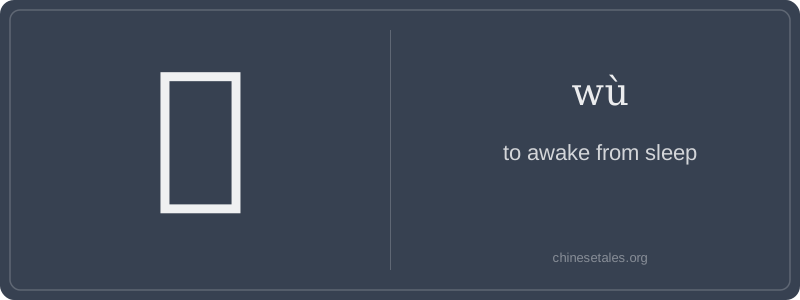
The earliest form of 寤 appears in bronze inscriptions as a complex pictograph: a roof (宀) sheltering a kneeling figure (勿, later evolving into 元 + 罒) whose head tilts upward — eyes wide open, arms raised in startled recognition. Over time, the kneeling posture simplified; the 'eye' element (目) became stylized into 罒 (a net-like radical representing perception), while the top evolved into 元 (origin, head), and the bottom added 悟’s semantic echo — a conscious realization. By the Han dynasty, the structure solidified into 宀 (roof) + 午 (phonetic, hinting at wù) + 罒 + 元 — visually encoding 'awakening under shelter, with full mental clarity.'
This visual logic shaped its meaning: 寤 wasn’t about mere physiological arousal, but *conscious emergence* — especially from dreams or delusion. In the Book of Songs, '辗转反侧,寤寐思服' describes tossing all night, awake *and* dreaming, consumed by longing — 寤 (awake) and 寐 (asleep) form a yin-yang pair. Later, in Tang dynasty poetry and Neo-Confucian commentaries, 寤 became synonymous with sudden enlightenment — Zhu Xi used it to describe the moment one grasps moral principle. Its shape still whispers: beneath the roof of self, the head lifts, the eyes open, and understanding arrives.
Think of 寤 (wù) as Chinese literature’s version of the 'epiphany moment' in a Shakespeare soliloquy — not just opening your eyes, but *awakening into awareness*, often with emotional or spiritual weight. It’s far more poetic and literary than everyday ‘wake up’ verbs like 醒 (xǐng) or 起 (qǐ). You’ll almost never hear it in casual speech — no one says ‘wù le!’ when stumbling out of bed at 7 a.m. Instead, it appears in classical poetry, historical texts, or solemn prose, always implying a sudden, meaningful transition from unconsciousness to clarity.
Grammatically, 寤 functions primarily as a verb, usually in compound form (e.g., 寤寐, 寤言), and is almost always transitive or used with modifiers indicating intensity or context (e.g., 悚然寤, 'startled awake'). Unlike 醒, which freely takes aspect particles (醒过来了), 寤 resists them — you won’t see 寤了 or 寤着. Its past-tense nuance is baked into the character itself, so it’s typically paired with classical adverbs (忽寤, 既寤) or embedded in parallel structures: '寤寐思服' (awake or asleep, I long for you — Book of Songs).
Culturally, 寤 carries echoes of Daoist and Confucian self-cultivation — awakening isn’t biological; it’s moral or existential. Learners often misapply it thinking it’s a fancy synonym for 'wake up', leading to jarringly archaic sentences ('我寤了' sounds like a Ming dynasty scholar just emerged from meditation). Also, its radical 宀 (roof) hints at an indoor, sheltered awakening — not dawn breaking outdoors, but consciousness dawning *under cover*, within the private realm of mind and dream.