寀
Character Story & Explanation
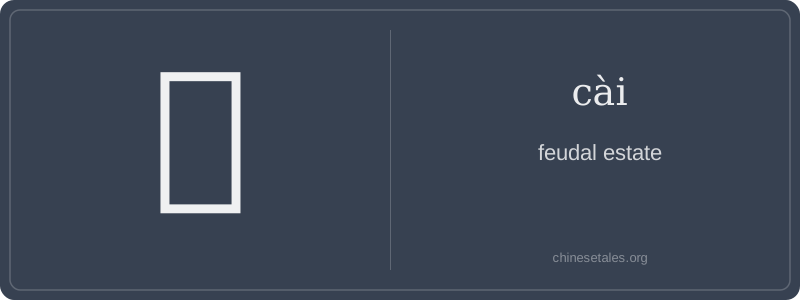
The earliest form of 寀 appears in bronze inscriptions of the Western Zhou (c. 1046–771 BCE), where it was written as ⿱爫田 — a hand (爫, representing 'grasping' or 'bestowing') hovering over a field (田). This wasn’t just any field: 田 was stylized as a grid of four plots, symbolizing surveyed, taxable land. Over centuries, the hand radical simplified into 宀 (roof — misread later as 'covering/protection'), while the lower part evolved from 田 to 釆 (a variant depicting 'distinguishing grain types'), reinforcing the idea of *administering* land — not just farming it.
By the Han dynasty, 寀 appeared in texts like the *Book of Rites* (《礼记》) to denote fiefs granted to nobles who ‘served the ruler and received 寀’. The character’s visual duality — roof + discernment — subtly encoded its function: a domain under sovereign oversight, requiring wise stewardship. Later scholars even linked 釆 to 'selecting tribute', underscoring that 寀 wasn’t passive ownership but active governance tied to loyalty and performance.
Think of 寀 (cài) as China’s ancient version of a 'manor house deed' — not the building itself, but the *legal right* to govern and profit from a stretch of land granted by the king. It’s deeply feudal: you don’t just own the soil; you collect taxes, administer justice, and answer only to the sovereign. Unlike modern property terms like 地 (dì, 'land') or 产 (chǎn, 'property'), 寀 carries weighty political hierarchy — it’s about delegated authority, not real estate listings.
Grammatically, 寀 is almost never used alone today. It appears exclusively in classical compounds or literary allusions — like a Latin root in English ('reg-' in 'regal', 'realm'). You’ll see it in phrases such as 采邑 (cǎi yì), where 采 is an archaic variant form (same pronunciation, same meaning). Learners mistakenly try to use it as a verb ('to grant an estate') or confuse it with common homophones — but 寀 is strictly a noun, fossilized in formal historical writing.
Culturally, mixing up 寀 with similar-sounding characters risks sounding either archaically poetic or unintentionally absurd. Native speakers rarely utter it aloud — it lives on paper, in history textbooks and classical poetry footnotes. Its silence in spoken Mandarin is part of its charm: it’s a whisper from the Zhou dynasty bureaucracy, preserved in ink but long retired from conversation.