孖
Character Story & Explanation
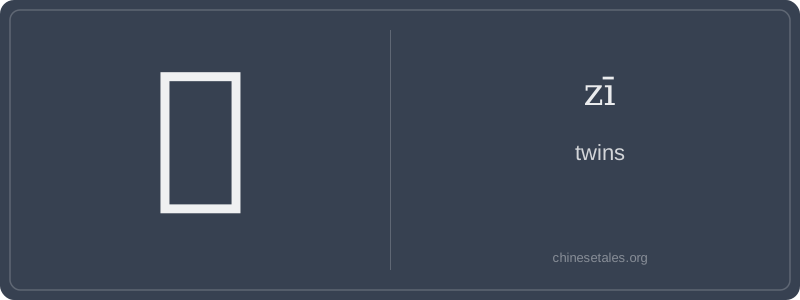
The character 孖 has no oracle bone or bronze script ancestry — it’s a late, ingenious folk creation. Its earliest attested form appears in Southern Song dynasty (12th–13th c.) regional manuscripts as two identical 小 (xiǎo, 'small') characters stacked vertically — a direct, literal pictorial pun: 'small + small = twins'. Over centuries, the top 小 simplified into two parallel horizontal strokes with a dot, and the bottom 小 morphed into a stylized 'child' shape (子), yielding today’s 孖: two 'children' fused into one glyph. Visually, it’s a masterclass in rebus logic — no phonetic component, no radical — just pure semantic doubling.
This visual logic shaped its meaning from day one: not just 'two people', but specifically 'two born together'. Unlike classical terms like 二生 (èr shēng) or 雙生 (shuāng shēng), 孖 emerged organically in vernacular speech, favored by midwives, grandparents, and opera troupes in the Pearl River Delta. It appears in Ming-Qing folk ballads describing twin heroes, and later in Cantonese opera scripts where 孖兄 (zī xiōng, 'twin elder brother') signals narrative symmetry and fate. Its form — literally 'two children' — never drifted; its meaning stayed anchored in biological, blessed duality — a rare case where a character’s birth, shape, and soul remained perfectly aligned across 800 years.
At first glance, 孖 (zī) feels like a linguistic relic — it’s not in the HSK, rarely appears in formal textbooks, and you won’t hear it on CCTV news. Yet in southern China, especially Guangdong and Hong Kong, it pulses with warm, colloquial life: it means 'twins', but carries an affectionate, almost familial weight — like calling twins 'the matched pair' or 'the double blessing'. It’s not abstract; it’s tactile, visual, intimate — evoking identical outfits, shared birthdays, and that uncanny synchrony only twins know.
Grammatically, 孖 is almost always used as a prefix before nouns — never alone. You’ll see 孖女 (zī nǚ, 'twin daughters'), 孖仔 (zī zǎi, 'twin sons' — note the Cantonese-influenced 仔), or even 孖生 (zī shēng, 'twin-born'). Crucially, it’s *not* a verb or adjective: you can’t say 'they 孖'; you must say '他们是孖仔' or '她有一对孖女'. Learners often mistakenly treat it like English 'twin' — trying to use it predicatively or without a noun — which instantly flags them as non-native in Cantonese-speaking circles.
Culturally, 孖 reflects how Chinese values kinship symmetry and auspicious doubling — two of the same thing signals harmony, balance, and fortune (think of red envelopes with even numbers). But here’s the twist: 孖 is virtually absent in Mandarin-dominant regions — it’s a lexical marker of Cantonese identity and regional pride. Mistaking it for standard Mandarin is like ordering 'soda' in London and expecting a fizzy drink — technically correct, but contextually revealing. Also, don’t confuse it with 双 (shuāng): while both mean 'pair/twin', 双 is neutral, formal, and pan-dialectal; 孖 is tender, local, and visually unforgettable.