媭
Character Story & Explanation
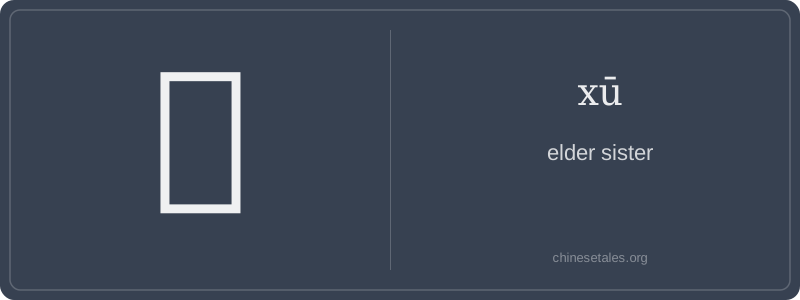
The earliest form of 媭 appears not in oracle bones, but in Warring States bronze inscriptions and Chu bamboo slips — where it’s written as 姁, later standardized as 媭. Its left radical is nǚ (女, 'woman'), anchoring it in kinship and gendered roles; its right component is xū (須), originally depicting 'beard' (a man’s facial hair), but here serving phonetically. Crucially, the 'xū' part wasn’t chosen for meaning — it was borrowed for sound, matching the local Chu pronunciation of the word for elder sister. Over centuries, the character stabilized into its current 12-stroke form: the feminine radical firmly on the left, the phonetic 'xū' on the right, visually balancing gender and sound.
This character didn’t evolve from a pictograph of sisters — it emerged from linguistic pragmatism: scribes needed a way to write the distinct Chu word for elder sister, so they combined ‘woman’ + ‘xū’ (sound-alike). It appears in the Chu Ci’s ‘Jiu Zhang’ section, where ‘Xū’ names a compassionate, guiding female figure — sometimes interpreted as a real sister, sometimes as a personified virtue. Its survival isn’t due to daily use, but to literary prestige: scholars preserved it because Qu Yuan used it, giving it an aura of lyrical authenticity no textbook term could replicate.
Imagine a quiet courtyard in ancient Chu state, where a young girl bows deeply to her elder sister before setting off on a ritual journey — not as a subordinate, but as someone receiving sacred guidance. That elder sister is called 媭 (xū), a term steeped in reverence, intimacy, and regional identity. Unlike the neutral jiějie or formal zǐmèi, 媭 carries poetic weight: it’s not just 'older sister' — it’s the elder sister who holds ancestral knowledge, who combs your hair before rites, who speaks with quiet authority in family lore. You’ll almost never hear it in modern Beijing Mandarin; it lives in classical poetry, southern dialects, and the mouths of elders recalling pre-20th-century speech.
Grammatically, 媭 functions as a noun — always standalone or modified by kinship prefixes like ‘ā’ (Āxū) or ‘dà’ (Dàxū), but never used with ‘de’ or as a verb. Learners mistakenly try to say ‘wǒ de xū’ (my elder sister) — but that’s unnatural; instead, it appears contextually: ‘Xū shuō…’ (Elder sister said…) or ‘Gēn xū qù’ (Go with elder sister). It resists modern grammatical scaffolding — like a character that politely refuses to be conjugated.
Culturally, 媭 evokes the Chu cultural sphere (modern Hubei/Hunan), appearing in the Chu Ci — especially in Qu Yuan’s elegies, where ‘Xū’ often refers to a lamenting, wise female relative. Modern learners rarely encounter it outside literary study, so mistaking it for common words like xū (‘need’) or xū (‘empty’) is common — but this xū has zero to do with emptiness or necessity. It’s full of presence, memory, and sisterly gravity.