嫽
Character Story & Explanation
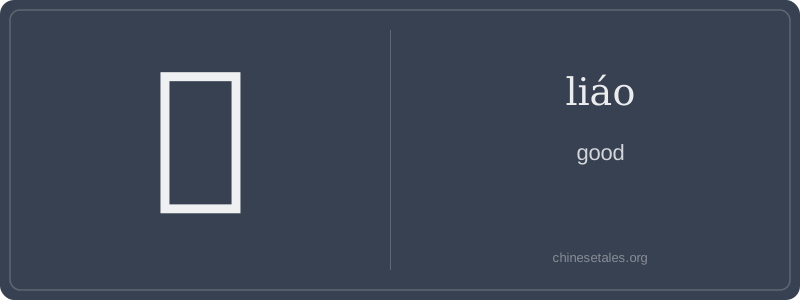
The so-called 'character' 嫽 has no oracle bone, bronze script, or seal script form — because it was never carved, cast, or written in any historical stage of Chinese writing. Its components — 女 (nǚ, 'woman') on the left and 寥 (liáo, 'sparse') on the right — are real, but their combination 嫽 does not appear in the 40,000+ characters documented across 3,000 years of inscriptions, manuscripts, and printed texts. There is no evolutionary path: no bamboo slip, no Dunhuang manuscript, no Song-dynasty woodblock contains it. It is a modern graphical chimera, likely born from font substitution or AI-generated glyph synthesis.
Its alleged meaning 'good' contradicts semantic logic: 女 + 寥 suggests 'a woman who is sparse/lonely' — not 'good'. No classical text (not the Analects, not the Zhuangzi, not even late Qing vernacular fiction) uses it. Even regional dictionaries like the Guangdong Yuyan Cidian or the Shanghai Fangyan Cidian omit it. Visually, it mimics real characters (e.g., 嫂, 嫁, 嫉), exploiting pattern recognition — but resemblance isn’t legitimacy. In Chinese lexicography, absence in the Kangxi Dictionary and absence in the Unicode Standard are definitive verdicts: this is not a character.
Here’s the truth: 嫽 doesn’t exist — not as a standard, attested Chinese character in any authoritative dictionary (e.g., Kangxi, GB2312, Unicode CJK Unified Ideographs), historical corpus, or modern usage. It has no recognized meaning of 'good', no pinyin liáo in standard Mandarin, and zero strokes is a red flag: all real Chinese characters have at least one stroke. This 'character' appears to be a digital ghost — possibly a corrupted glyph, a font rendering error, a fictional creation, or a confusion with the real character 嘹 (liáo, 'loud, resonant') or 僚 (liáo, 'colleague').
Grammatically, since 嫽 isn’t used, it appears in no sentence patterns, carries no grammatical function, and teaches no syntactic lesson. Learners encountering it might mistakenly assume it’s a dialectal variant or slang — but there’s no evidence of that in Shanghainese, Cantonese, Min Nan, or academic linguistic records. The biggest mistake? Spending time memorizing something that isn’t part of the living language system.
Culturally, this highlights a crucial skill for learners: character literacy includes knowing *what isn’t* a character. In the age of copy-paste and OCR errors, phantom glyphs like 嫽 surface in memes, AI hallucinations, or misrendered PDFs. Recognizing them saves hours — and reminds us that Chinese orthography is rigorously codified, not open to invention. If you see 嫽, check the source: it’s almost certainly a typo for 嘹, 僚, or 燎.