嫠
Character Story & Explanation
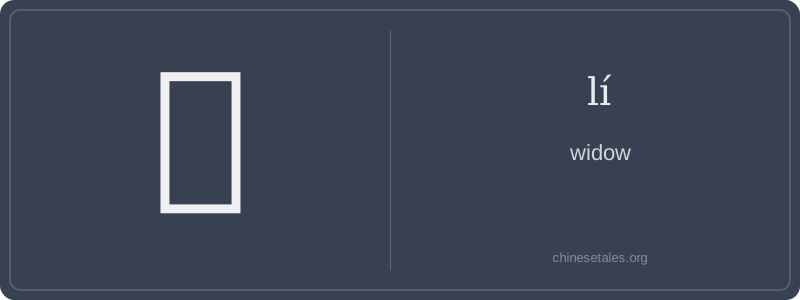
The earliest form of 嫠 appears in Warring States bamboo slips — not oracle bones — and already shows its defining structure: the 女 (nǚ, 'woman') radical on the left, and a right side derived from 黎 (lí, 'black; dawn; multitudes'), which originally depicted a person under a roof with grain stalks, symbolizing 'common people at daybreak'. Over centuries, 黎 simplified and fused with 女, retaining its phonetic role (lí) while visually suggesting a woman bearing the weight of collective hardship — not just personal loss, but societal expectation.
By the Han dynasty, 嫠 had crystallized as a literary term for widows who upheld ritual propriety after their husband’s death — especially those who refused remarriage and managed ancestral rites. It appears in Ban Zhao’s *Lessons for Women* (Nüjie) and Tang poetry, where 嫠妇 (lí fù) evokes moonlit courtyards and unspun silk — metaphors for suspended life and unbroken fidelity. Crucially, the character’s visual duality matters: the 'woman' radical grounds it in gendered experience, while 黎’s meaning ('the common people') hints that her suffering was both individual and emblematic — a microcosm of social order tested by loss.
At first glance, 嫠 (lí) seems like a straightforward term for 'widow' — but in Chinese, it’s far more evocative and culturally loaded. Unlike the neutral 独身女性 (dúshēn nǚxìng, 'unmarried woman') or even 寡妇 (guǎfù, the more common modern word for widow), 嫠 carries classical gravity and poetic austerity. It’s rarely used in spoken Mandarin today; you’ll encounter it almost exclusively in literary texts, historical dramas, or formal elegies — where it conveys not just marital status, but moral endurance, quiet dignity, and social isolation rooted in pre-modern gender expectations.
Grammatically, 嫠 functions as a noun and almost never appears alone in modern usage — it’s always embedded in compounds (e.g., 嫠妇, 孤嫠) or modified by adjectives like 贞 (zhēn, 'chaste') or 孤 (gū, 'bereft'). You won’t say *'她是个嫠' — that would sound archaic and incomplete. Instead, you’d say 她是位贞嫠 (tā shì wèi zhēn lí, 'She is a chaste widow'), echoing classical syntax. Learners often mistakenly treat it like a standalone colloquial noun — a red flag that instantly reveals non-native fluency.
Culturally, 嫠 subtly encodes Confucian ideals: the widow who remains unmarried, manages her household, raises children alone, and upholds family virtue becomes a moral exemplar — hence the character’s frequent pairing with words like 节 (jié, 'integrity') and 烈 (liè, 'resolute'). Misusing it as a casual synonym for 'widow' risks sounding either comically overblown or unintentionally disrespectful — like calling someone a 'virtuous martyr' instead of just 'a widow'. Its rarity today makes it a linguistic time capsule: elegant, heavy, and deeply contextual.