妪
Character Story & Explanation
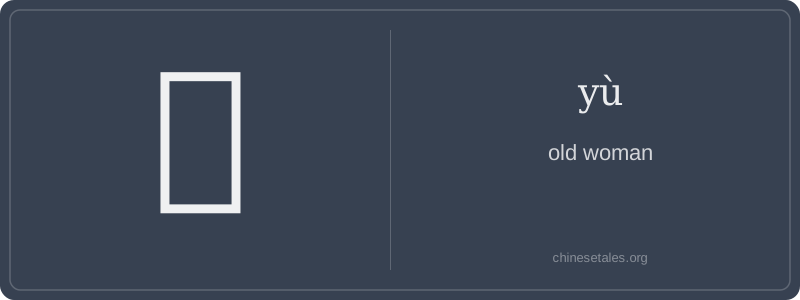
The earliest form of 妪 appears in seal script as a combination of 女 (woman) on the left and 区 (qū, originally a curved container or coiled shape) on the right. The ‘区’ component wasn’t phonetic at first—it suggested enclosure, containment, perhaps the rounded posture of age or the sheltering role of elder women in early agrarian clans. Over centuries, the right side simplified from complex bronze-era curves into today’s 区: three strokes forming a compact, slightly hunched frame—visually echoing how elders stand or sit. Crucially, the radical 女 stays prominent, anchoring the meaning firmly in gender and social identity.
By the Han dynasty, 妪 appeared in texts like the Shuōwén Jiězì, defined as ‘an elderly woman who has borne children’. Its usage deepened in Tang poetry—Du Fu described refugees fleeing war as ‘老妪力虽衰’ (‘Though the old woman’s strength is spent’), highlighting resilience over frailty. Unlike many characters that softened in tone over time, 妪 retained its solemn register: never ironic, never affectionate, always quietly authoritative—a linguistic monument to unnamed women who held families and villages together across dynasties.
Imagine walking down an ancient alley in Chang’an during the Tang Dynasty—you pass a bent-backed woman sweeping fallen apricot blossoms, her sleeves patched, her voice soft but steady as she hums a lullaby to a sleeping child. That’s not just any old woman; that’s an yù—a term soaked in quiet dignity, gentle authority, and lived-in wisdom. In modern Chinese, 妪 isn’t slang or diminutive like ‘granny’ or ‘old lady’; it’s literary, respectful, and often appears in formal writing, historical narratives, or poetic description—not daily speech.
Grammatically, 妪 is a noun, never used alone in casual conversation (you’d say 老奶奶 or 阿婆 instead). It appears in subject or object position, usually modified: 一位老妪, 白发老妪, or after classifiers like 位 or 名. You’ll almost never hear it in spoken Mandarin without at least one modifier—it’s too stark on its own. Also, don’t confuse it with 姑 or 婆: 妪 carries no familial relationship—it’s purely age- and gender-based, neutral yet reverent.
Culturally, 妪 evokes Confucian ideals of elder respect without sentimentality—it’s neither pitiful nor cutesy. Learners often overuse it thinking it’s ‘the standard word for old woman’, but native speakers reserve it for moments that demand gravitas: obituaries, classical retellings, or essays about rural life. A classic mistake? Using it in dialogue—no one says ‘您好,妪!’—that would sound like quoting a Ming-dynasty novel aloud at breakfast.