媸
Character Story & Explanation
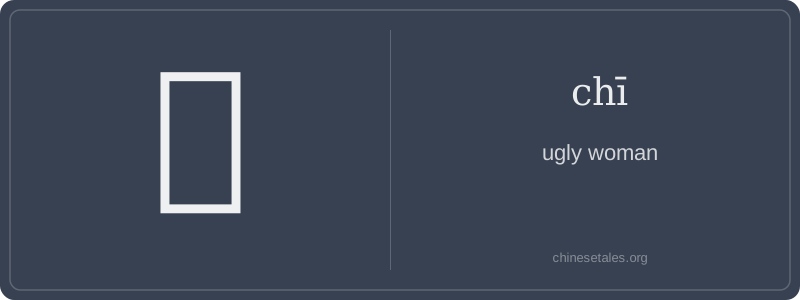
The earliest form of 媸 appears in late Warring States bamboo slips, not oracle bones — and it’s a masterclass in visual irony. Its left side, 女 (nǚ), is standard: a kneeling woman figure. But the right side, 斎 (zhāi), is a clever corruption of an older form meaning 'to purify' or 'to fast' — originally drawn with three 'drops' (representing ritual water) beneath a roof. Over centuries, scribes simplified those drops into the three horizontal strokes atop 斎, while the roof became the top bar — transforming a symbol of purity into something visually heavy, asymmetrical, and subtly 'off-kilter' — mirroring the character’s semantic charge.
This visual tension shaped its meaning: by the Han dynasty, 媸 had crystallized as a literary term for women whose looks disrupted Confucian ideals of harmonious grace — not merely unattractive, but *dissonant*. It appears in Ban Zhao’s *Nüjie* (Admonitions for Women, 1st c. CE) to caution against vanity that invites such judgment, and later in Tang poetry where poets contrast 媸 with 妍 to explore the subjectivity of beauty. The character itself — with its uneven stroke distribution (the 女 radical leans left, 斎 bulks right) — feels unbalanced, almost lopsided: a rare case where the calligraphy physically embodies its meaning.
Think of 媸 as Chinese literature’s equivalent of a Shakespearean insult — not crude, but surgically precise: it doesn’t just mean 'ugly'; it means 'a woman whose appearance violates classical aesthetic expectations,' often with a hint of moral or social judgment. Unlike generic terms like 丑 (chǒu), which applies to anyone or anything unattractive, 媸 carries gendered, literary weight — like calling someone a 'shrew' in Elizabethan English: technically descriptive, but dripping with cultural baggage.
Grammatically, 媸 is almost always used as a noun (a 'ugly woman') or in fixed classical compounds — you won’t hear it in casual speech or modern headlines. It rarely takes modifiers ('very 媸' sounds archaic and jarring), and never functions as a verb or adjective on its own. A common learner mistake is trying to use it like 丑 — e.g., saying '她很媸' — but that’s grammatically off; instead, you’d say '此女甚媸' (this woman is extremely 媸), echoing classical syntax.
Culturally, 媸 appears mostly in historical novels, opera libretti, or satirical essays critiquing superficial beauty standards — think of it as the Mandarin cousin of 'hag' or 'crone' in fairy tales: evocative, stylized, and deliberately antiquated. Modern speakers might recognize it from idioms like 媸妍毕露 (chī yán bì lù — 'ugliness and beauty fully revealed'), where it pairs with 妍 (yán, 'graceful beauty') to form a poetic antithesis. Don’t reach for 媸 when texting your friend — save it for writing a Ming-dynasty-style satire.