媲
Character Story & Explanation
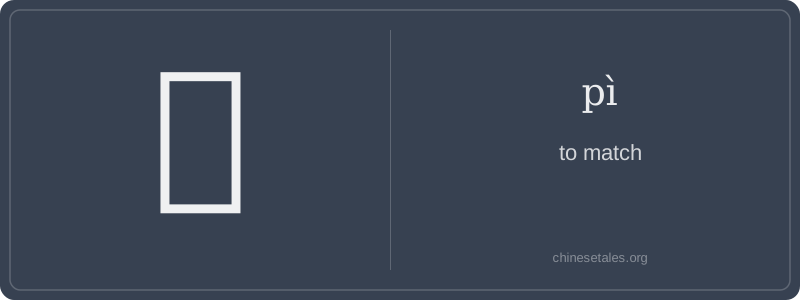
Oracle bone inscriptions show no direct precursor for 媲, but its seal script form (c. 1000 BCE) reveals its blueprint: a woman radical (女) fused with 『辟』(bì/pì), which originally depicted a ruler clearing land with an axe — symbolizing authority, opening, and establishing order. Over centuries, the right side simplified from 辟’s complex 13-stroke form (with 邑 + 辛 + 丌) into today’s streamlined 『辟』component, while the left-side 女 remained steadfast — anchoring the character’s association with human excellence, not abstract equivalence.
By the Han dynasty, 媲 appeared in texts like the Shuōwén Jiězì, defined as 'matching in virtue or achievement'. Its meaning crystallized through parallelism in classical rhetoric: phrases like '才媲子建' (cái pì Zǐjiàn, 'talent matching Cao Zhi') elevated poetic skill to moral parity. Visually, the 13 strokes form a balanced yet dynamic tension — the soft curves of 女 counterpointed by the sharp angles of 辟 — mirroring its semantic role: grace meeting rigor, humanity meeting standard.
Think of 媲 (pì) as Chinese’s version of the Olympic 'side-by-side comparison' — not just 'equal to', but 'worthy of standing shoulder-to-shoulder with'. It carries quiet prestige, like comparing a young violinist’s debut to Itzhak Perlman’s early recordings: not identical, but *commensurate in stature*. Unlike generic verbs like 比 (bǐ, 'to compare') or 等于 (děngyú, 'equals'), 媲 is exclusively used in formal, literary, or rhetorical contexts — almost always in the pattern 'A 媲 B' ('A matches B in excellence'), never alone or in casual speech.
Grammatically, it’s a transitive verb that demands symmetry and high register. You’ll never hear it in a café order ('This coffee doesn’t 媲 that one'); instead, you’ll find it in award speeches ('Her dedication 媲 any Nobel laureate') or classical-style essays. Learners often mistakenly treat it like 比 and try to use it with particles like 得 or 了 — but 媲 takes no aspect markers, no complements, and no object pronouns. It stands tall and uninflected, like a bronze statue on a plinth.
Culturally, 媲 evokes Confucian ideals of measured excellence — not raw superiority, but harmonious parity worthy of mutual respect. A common mistake is overusing it in writing, mistaking formality for fluency; native editors often replace it with 更胜一筹 (gèng shèng yī chóu, 'a notch above') or 不相上下 (bù xiāng shàngxià, 'neck-and-neck') for natural flow. Reserve 媲 for moments when you want your words to shimmer — like quoting poetry or honoring mastery.