媛
Character Story & Explanation
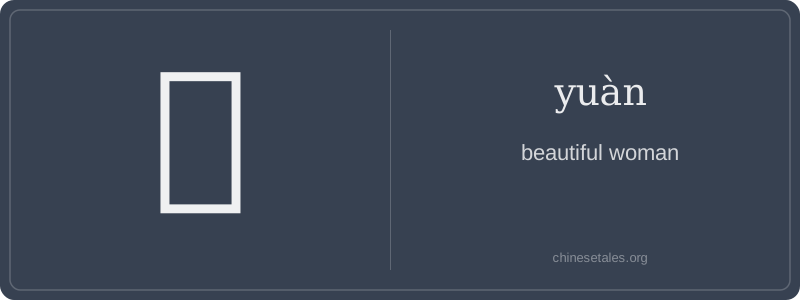
The earliest form of 媛 appears in bronze inscriptions (c. 1000 BCE) as a compound pictograph: the left side was 女 (nǚ, 'woman') — drawn with flowing hair and bent posture — and the right side was 源 (yuán, 'source' or 'spring'), which itself evolved from water droplets flowing from a mountain. Over centuries, 源 simplified into the phonetic component 爰 (yuán), preserving the sound while losing the water imagery — yet keeping the sense of 'originating grace.' By the Han dynasty, the character stabilized into its modern 12-stroke structure: 女 + 爰, with the latter’s distinctive 'claw-and-spring' shape (爫 + 友 + 儿).
This visual fusion reflects its semantic evolution: the 'woman' radical anchors it in gendered identity, while the phonetic 爰 (yuán) subtly reinforces the idea of innate, wellspring-like elegance — not surface prettiness, but beauty emerging organically from cultivation and character. In the Shijing (Book of Odes), 媛 appears in odes praising noblewomen whose virtue 'flows like a clear spring,' linking physical beauty to moral clarity. Later, during the Tang and Song dynasties, poets used 媛 to evoke ethereal, otherworldly women — celestial maidens or muse-like figures — cementing its association with transcendent, cultured femininity.
Think of 媛 (yuàn) as Chinese literature’s ‘Lady Fair’ — not just any beautiful woman, but one with refined grace and cultivated virtue, like a Jane Austen heroine who speaks classical poetry and plays the qin. Unlike generic terms like měinǚ (beautiful woman), 媛 carries literary elegance and quiet dignity; it’s rarely used in casual speech or modern ads, but appears often in names, poetry, and formal descriptions — almost like calling someone a 'vision' rather than just 'hot'.
Grammatically, 媛 functions almost exclusively as a noun, typically in compound nouns or personal names. You’ll almost never see it alone in a sentence — no 'She is yuàn' — and it doesn’t take adjectives or aspect markers. It’s also tone-sensitive: mispronouncing it as yuán (like 'yuan' in yuanxiao) changes it to a different character entirely (媛 → 原). Learners sometimes try to use it like an adjective ('a yuàn girl'), but that’s ungrammatical — it’s always embedded, like in jīngyàn (experienced) + nǚ → jīngyàn nǚ, never *jīngyàn yuàn.
Culturally, 媛 has deep roots in Confucian ideals of feminine cultivation — beauty paired with virtue, education, and poise. That’s why it’s overwhelmingly favored in female given names (e.g., Lǐ Yùyuàn, Wáng Xīyuàn). A common mistake? Using it in spoken Mandarin when 'měilì de nǚshēng' would sound far more natural. Also beware: its rareness means even many native speakers pause before writing it — they double-check those 12 strokes!