婐
Character Story & Explanation
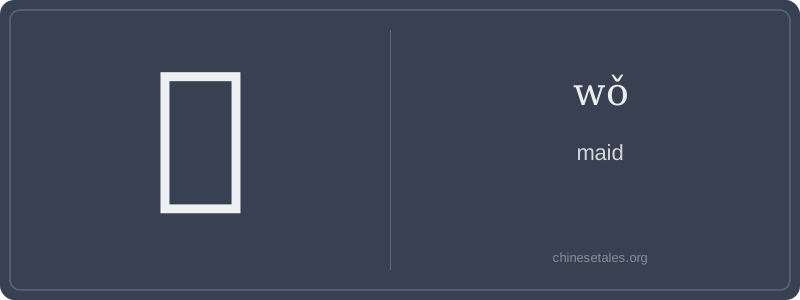
The earliest known form of 婐 appears on late Shang dynasty bronze vessels — not as a clear pictograph, but as a composite seal-script glyph: left side is 女 (a kneeling woman with exaggerated hair and hands), right side is 可 (originally a mouth 口 atop a peg-like 舌, signifying ‘approval’ or ‘permission’). Over centuries, the 女 radical simplified from a full figure to three strokes (爫 + 一 + 丶), while 可 lost its tongue shape and hardened into its modern box-and-leg structure. By Han dynasty clerical script, the two halves fused visually, though the semantic-phonetic division remained intact.
This fusion tells a cultural story: the ‘maid’ wasn’t defined by her labor alone, but by sanctioned role — literally ‘the woman who is permitted (by hierarchy) to serve’. In the Shuōwén Jiězì (121 CE), Xu Shen defines it as ‘a young female attendant in noble residences’, citing Zhou dynasty rites where such women underwent months of training in ritual posture and vessel handling. The character’s survival isn’t due to frequency, but to its precision: it named a specific social node in a rigidly stratified world — one where even service had liturgical weight.
Here’s the truth no textbook tells you: 婐 (wǒ) doesn’t mean ‘maid’ in modern spoken Mandarin — it’s functionally extinct. It survives only in pre-Qin bronze inscriptions and classical dictionaries as an archaic term for a young female servant, often one attached to noble households. The character carries a quiet gravity: not just labor, but status-bound intimacy — think of a girl entrusted with handling ritual bronzes or attending a princess’s hair. You’ll never hear it in Beijing subway announcements or HSK dialogues; its ‘meaning’ is less lexical and more archaeological.
Grammatically, 婐 was always a noun — never used adjectivally or in compounds during its active life. Unlike common servants’ terms like 丫鬟 (yāhuan) or 仆人 (púrén), 婐 appears almost exclusively in subject or object position in terse bronze-cast texts, often paired with verbs like 事 (shì, ‘to serve’) or 从 (cóng, ‘to accompany’). Example: ‘王命媐事宗庙’ — ‘The king ordered the maid to serve the ancestral temple.’ No particles, no measure words — just stark, ceremonial duty.
Learners’ biggest trap? Assuming it’s a ‘real’ word they can drop into conversation. It’s not. Confusing it with 我 (wǒ, ‘I’) is rare visually but catastrophic semantically — imagine saying ‘I am a maid’ when you meant ‘I am me’. Also, many misread its radical as 女 (nǚ, ‘woman’) alone, missing that the right side is actually 可 (kě) — a phonetic component, not a meaning hint. This isn’t vocabulary; it’s linguistic archaeology you hold in your hand.