婀
Character Story & Explanation
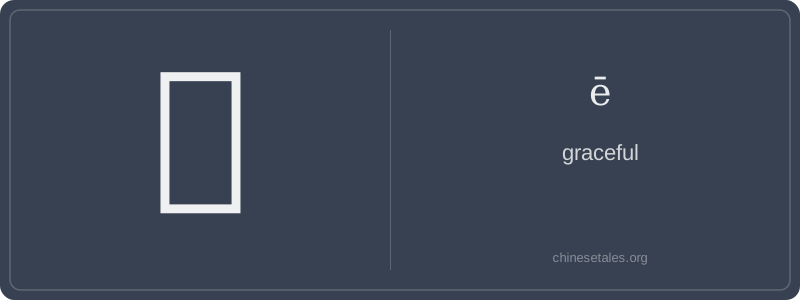
The earliest trace of 婀 appears not in oracle bones, but in Warring States bronze inscriptions and early seal script, where it emerged as a compound character: the left side 女 (nǚ, 'woman') anchors the meaning in femininity and posture, while the right side 阿 (ā) — originally depicting a winding mountain path or meandering river — provided both sound (*ā/ē* rhyme) and visual metaphor for gentle, sinuous movement. Over centuries, 阿 simplified from a complex pictograph of hills and curves into today’s streamlined 7-stroke component, while 女 retained its three-stroke silhouette — together forming the elegant 10-stroke balance we write now.
This fusion was deliberate: by Han dynasty, 婀 had crystallized in texts like the *Shuōwén Jiězì* (c. 100 CE) as 'graceful in bearing, especially of women'. It flourished in Tang poetry — Li Bai wrote of '婀娜多姿的柳枝' (willow branches, slender and full of grace), where the character’s very shape mirrors the bend of a willow limb. Its double curve (in both 女’s slanting strokes and 阿’s rounded right side) isn’t accidental: Chinese scribes literally carved grace into the character’s architecture — every stroke leans, yields, and flows.
Think of 婀 (ē) as the Chinese equivalent of 'willowy' — not just graceful, but *delicately, almost unnervingly* so: imagine a willow branch swaying in slow motion, or a ballet dancer’s sustained arabesque — it’s grace with quiet tension and subtle curvature. Unlike general terms like 优美 (yōu měi, 'elegant') or 雅 (yǎ, 'refined'), 婀 carries a distinctly feminine, lyrical softness rooted in physical poise — and it almost never stands alone. You’ll rarely see it solo; it’s a team player, nearly always paired in reduplicated form (婀娜) or in poetic compounds.
Grammatically, 婀 is almost exclusively adjectival and literary — it modifies nouns directly ('婀娜的身姿') or appears in fixed four-character idioms. It does *not* take aspect particles (了, 过), nor does it function predicatively without support ('她很婀娜' sounds archaic or jarringly ornate — native speakers would say 她姿态优雅 instead). Learners often misapply it to abstract concepts ('graceful thinking') — but 婀 is stubbornly embodied: it describes curves, silhouettes, gait, movement, and sometimes sound (like wind through reeds).
Culturally, 婀 evokes classical aesthetics — think Tang dynasty poetry or Song dynasty ink paintings where a single curved line conveys rhythm and breath. Modern usage is rare outside literature, lyrics, or formal descriptions (e.g., tourism brochures describing bamboo groves). A common mistake? Pronouncing it as ě (third tone) — but it’s firmly ē (first tone), matching its serene, unbroken quality. Also, don’t confuse it with 矮 (ǎi, 'short') — same radical? No — different radical entirely, and zero semantic overlap.