姝
Character Story & Explanation
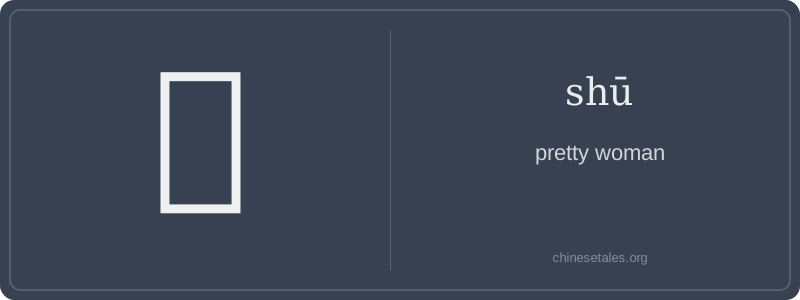
The earliest form of 姝 appears in bronze inscriptions of the Western Zhou dynasty (c. 1046–771 BCE), where it was written with the ‘woman’ radical (女) on the left and a phonetic component that resembled 叔 (shū, ‘uncle’) on the right — but simplified over centuries. Originally, the right side wasn’t 叔 itself, but a stylized glyph representing ‘a hand holding a staff,’ later misinterpreted and standardized into 叔. The nine strokes coalesced by the Han dynasty: the three-stroke 女 radical (skirt, bent knees, hair) anchors the left, while the six-stroke 叔 — with its distinctive ‘tree’ (木) base and ‘uncle’-related upper — completes the visual balance.
This character first appeared in the *Shījīng* (Classic of Poetry), where 姝 described noblewomen praised for both appearance and virtue — e.g., ‘静女其姝’ (Jìng nǚ qí shū), ‘The quiet girl is so gracefully fine.’ Notice how ‘quiet’ precedes ‘graceful’: beauty here is inseparable from stillness and decorum. The shape itself reinforces this — the poised, centered ‘woman’ beside the upright, authoritative ‘uncle’ component suggests a woman whose dignity is affirmed by tradition. Even today, the character feels like a miniature scroll painting: composed, deliberate, and quietly resonant.
Think of 姝 (shū) as Chinese literature’s ‘Belle’ — not the Disney princess, but the kind you’d find in a Tang dynasty poem: refined, quietly radiant, and never vulgarly flashy. It doesn’t mean ‘beautiful’ in the generic sense like 美 (měi) or 漂亮 (piào liang); it specifically evokes a graceful, virtuous, traditionally elegant woman — one whose beauty is inseparable from her poise and moral bearing. You’ll almost never hear it in casual speech; it lives in classical allusions, poetic names, and formal written registers.
Grammatically, 姝 functions almost exclusively as a noun or attributive noun — never as a verb or standalone adjective. You won’t say *‘she is 姝’*; instead, you’ll see it in compounds like 姝丽 (shū lì, ‘gracefully lovely’) or as part of a given name (e.g., 李姝, Lǐ Shū). Learners often mistakenly try to use it predicatively (*‘这个女孩很姝’*), which sounds jarringly archaic — like saying ‘This maiden doth shimmer’ at a coffee shop.
Culturally, 姝 carries a quiet Confucian elegance — it’s beauty filtered through restraint and cultivation. Unlike modern slangy terms for attractiveness, 姝 implies inner harmony reflected outwardly. A common pitfall? Overestimating its frequency: it’s rare in daily life but prized in naming traditions, where parents choose it to evoke timeless grace — much like naming a child ‘Seraphina’ in English, not ‘Pretty.’