妣
Character Story & Explanation
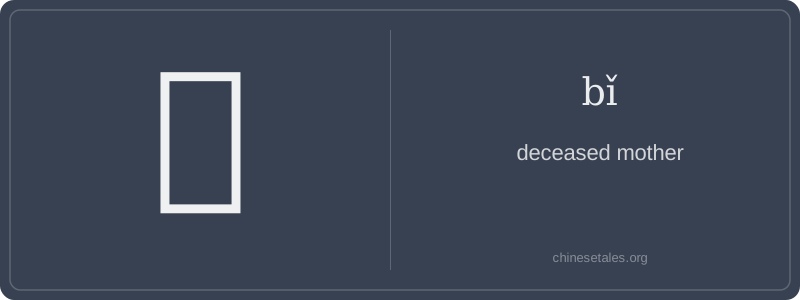
The earliest form of 妣 appears in Shang dynasty oracle bone inscriptions as a combination of 女 (a kneeling woman) and 比 (originally two people facing each other, later simplified to two parallel strokes). In bronze script, it evolved into a clear left–right structure: the 女 radical on the left (emphasizing gender and kinship), and 比 on the right — not for 'comparison', but as a phonetic component hinting at the ancient pronunciation *pʰrəʔ. Over centuries, the right side standardized into today’s two horizontal strokes above two shorter ones — a visual echo of 'paired reverence'.
This character crystallized during the Zhou dynasty as part of the 'dual ancestral title' system: 考 (kǎo) for deceased father, 妣 (bǐ) for deceased mother — together forming 考妣 (kǎo bǐ), a phrase still used in formal epitaphs and memorial addresses. Mencius (3B:2) references them as moral anchors: 'A man who does not honor his 考妣 lacks humanity.' The character’s enduring rigidity reflects how deeply Confucian filial piety encoded kinship hierarchy into writing itself — not just who your parents were, but *how you name them after death*.
Think of 妣 (bǐ) as Chinese classical literature’s version of 'Mother Deceased' on a Victorian mourning card — formal, reverent, and strictly reserved for ritual contexts. Unlike the warm, everyday term 妈妈 (māma) or even the respectful 母亲 (mǔqīn), 妣 carries the hushed gravity of an ancestral tablet inscription: it refers *only* to one’s own mother *after her death*, never while she’s alive, and almost never in casual speech. It’s a fossilized honorific — like calling your late grandmother 'Her Grace' instead of 'Grandma.'
Grammatically, 妣 is a noun that functions exclusively in formal, literary, or ritual collocations — you’ll find it paired with words like 先 (xiān, 'late') or 考 (kǎo, 'deceased father'), as in 先妣 (xiān bǐ). It never takes aspect particles (了, 过), modifiers like 很 or 非常, or plural markers. You won’t say '我的妣们' — that’s not just unnatural, it’s linguistically impossible. Its syntax is as rigid as Confucian etiquette: it appears only in set phrases, often alongside its counterpart 考.
Culturally, learners often misread 妣 as a general word for 'mother' or confuse it with 母 — a mistake that could turn a solemn ancestral rite into unintentional absurdity. It’s absent from modern spoken Mandarin and HSK precisely because it lives in bronze inscriptions, Han dynasty steles, and Qing-dynasty genealogies — not WeChat chats. Using it outside classical or ceremonial contexts sounds archaic, even eerie, like quoting Shakespeare at a coffee shop.