妁
Character Story & Explanation
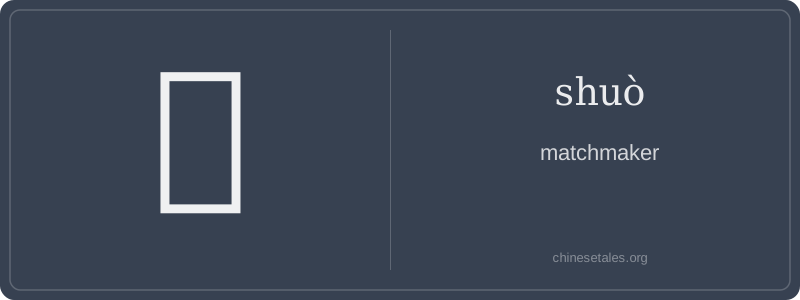
The earliest form of 妁 appears in Warring States bamboo texts — not oracle bones, but elegant ink inscriptions where the left side 女 (nǚ, 'woman') is already standard, while the right side was originally 曰 (yuē, 'to speak'), not 爽. Over time, scribes simplified 曰 into 爽 (shuǎng) — likely due to phonetic borrowing (both 曰 and 爽 were read with similar -uo/-uang rhymes in ancient layers) and visual streamlining. The six strokes crystallized: three for 女 (with the dot as the first stroke), then three for 爽 — two 'X'-like strokes crisscrossing a central vertical, evoking clarity and authority in speech.
This evolution wasn’t arbitrary: 爽 originally meant 'brightness, freshness', then extended to 'clarity of judgment' — perfect for a matchmaker whose role demanded discernment, honesty, and moral lucidity. Mencius (3B:2) famously wrote: 'Without媒妁之言, parents之命, not one man or woman dares to marry' — cementing 媒妁 as inseparable twins in ritual legitimacy. Visually, 女 + 爽 tells you: this is a woman whose words bring clarity to union — not gossip, but governance of kinship.
妁 is a quiet but culturally loaded character — it doesn’t just mean 'matchmaker'; it evokes the entire Confucian machinery of marriage as social alliance, not romance. In classical and literary Chinese, 妁 carries gravitas: this isn’t a casual dating app algorithm, but a respected (often elderly female) go-between who negotiates dowries, checks family genealogies, and ensures harmony between lineages. You’ll almost never hear it in spoken Mandarin today — it’s reserved for historical dramas, classical allusions, or ironic literary flair.
Grammatically, 妁 functions almost exclusively as a noun, typically embedded in compounds like 媒妁 or 媒妁之言 (méishuò zhī yán — 'the words of matchmakers', i.e., formal marriage arrangements). It rarely stands alone in modern usage; saying *'She is a 妁'* sounds archaic or deliberately stylized — like calling someone 'a soothsayer' instead of 'a fortune-teller'. Learners often mispronounce it as shuō (like 说) or confuse it with 媒 (méi), but 妁 is strictly shuò — a sharp, falling tone that mirrors its decisive role in sealing fates.
Culturally, 妁 reveals how deeply marriage was institutionalized: the matchmaker wasn’t optional — she was the legal and ritual gatekeeper. In pre-modern law, marriages without 媒妁 were sometimes deemed invalid. Today, using 妁 ironically — say, calling your meddling aunt a 'modern 妁' — lands with dry, knowing humor among native speakers. Mistake it for a generic 'woman' term? You’ll miss the weight of centuries of social choreography.