夒
Character Story & Explanation
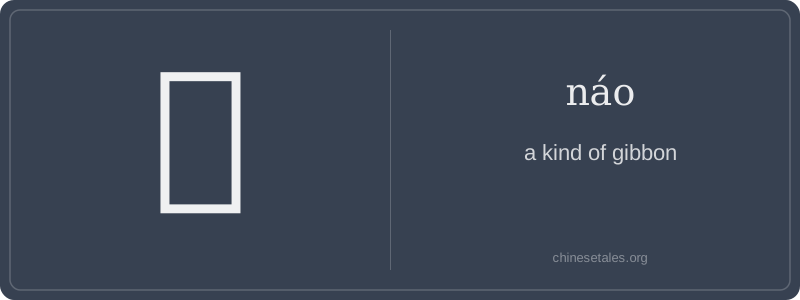
The earliest form of 夒 appears in oracle bone inscriptions as a striking, almost cartoonish pictograph: a head with exaggerated ears, two long, curved arms dangling downward, bent knees, and a tail curling behind — unmistakably a gibbon mid-swing. Over centuries, the script simplified: Shang bronze forms added angularity; Zhou seal script stylized the limbs into interlocking strokes; by the Han clerical script, the head shrank, the arms became parallel verticals (爫), and the lower body fused into 夂 — the ‘going slowly’ radical, ironically capturing the gibbon’s graceful, deliberate suspension rather than speed.
This visual evolution parallels its semantic journey: from a concrete, observed forest dweller in early Zhou hunting records, 夒 gained literary resonance in the *Chu Ci* (Songs of Chu), where it symbolizes exile and melancholy — its cry echoing across misty gorges. By the Tang dynasty, it had vanished from everyday use, surviving only in philological commentaries like the *Shuōwén Jiězì*, where Xu Shen defines it as ‘a beast resembling a monkey, with a human face and long arms’. Its very complexity preserved it — not as language, but as a monument to how vividly ancient scribes saw the natural world.
At first glance, 夒 (náo) feels like a linguistic fossil — it’s not used in modern spoken or written Chinese at all. It means 'a kind of gibbon', but not just any ape: in ancient texts, it evokes a mythical, intelligent, agile primate with long arms and mournful cries — the kind that inspired poets to write about solitude and wilderness. To native speakers, 夒 isn’t a word you’d utter; it’s a character you might glimpse in a dictionary footnote or an archaeological report, carrying the quiet weight of early zoological observation and mythic imagination.
Grammatically, 夒 functions only as a noun — never a verb, adjective, or component in compounds you’d encounter today. You won’t find it in verbs like ‘to climb’ or ‘to swing’, nor does it appear in modern animal names (gibbons are now called 长臂猿 chángbìyuán). Its sole grammatical role is as a classical lexical item: subject or object in archaic descriptions, like ‘the 夒 howled at dusk’. That means learners shouldn’t try to conjugate it or use it conversationally — doing so would sound like quoting a bronze inscription at a coffee shop.
Culturally, 夒 reveals how early Chinese classification blended observation, sound symbolism, and pictorial thinking: its pronunciation náo mimics a wailing cry, and its intricate shape mirrors the contorted posture of a leaping ape. A common mistake? Assuming it’s related to 猴 (hóu, ‘monkey’) — but they’re etymologically unrelated. Also, many misread its radical (夂, ‘to go slowly’) as ‘claw’ or ‘hand’, missing its subtle implication of deliberate, sweeping motion — like an arm reaching down from a branch.