壖
Character Story & Explanation
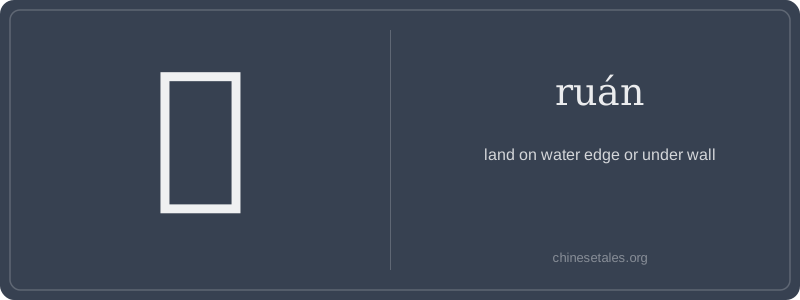
The earliest form of 壖 appears in Han dynasty bronze inscriptions and seal script, not oracle bones — it’s relatively late-born. Visually, it fuses three key elements: the radical 土 (tǔ, 'earth/soil') on the left, anchoring it in land; the phonetic component 而 (ér, 'and/thus') on the right top, hinting at pronunciation; and below that, 冖 (mì, 'cover') — a stylized roof or overhang, representing the protective arc of a wall or the canopy-like curve of a riverbank’s embankment. Over centuries, the 冖 softened into the dot-and-hook shape we see today, while 而 simplified from a pictograph of a beard (signifying maturity, continuity) to a phonetic placeholder.
This visual triad — earth + cover + continuity — crystallized its meaning: land persistently shaped *by* containment. In the Book of Han, 壖 appears in edicts allocating ‘river-margin land’ (河壖) to displaced farmers after floods — land too wet for crops but stable enough for reed harvesting. Later, Song poets used 城壖 to evoke melancholy stillness: the silent, shadowed strip beneath towering walls, where grass grows stubbornly in cracks. Its form literally holds the idea of earth held in check — not conquered, not abandoned, but carefully held in suspension between forces.
Think of 壖 (ruán) as the quiet, overlooked 'buffer zone' of Chinese geography — not quite land, not quite water, not quite wall, but the narrow strip where they meet. Its core meaning is 'land on the edge of water or under a wall,' evoking liminal, transitional space: the muddy margin of a riverbank, the shaded strip beneath a city rampart, or the reclaimed silt just beyond a dyke. It’s poetic, archaic, and deeply spatial — you won’t hear it in daily conversation, but it breathes in classical poetry and historical texts describing imperial fortifications or flood-control projects.
Grammatically, 壖 functions almost exclusively as a noun, often modified by classifiers like 片 (a stretch of) or 一帶 (a belt/zone of). It rarely stands alone; instead, it appears in compounds like 河壖 (riverbank margin) or 城壖 (area beneath city walls). Learners sometimes mistakenly treat it as a verb or try to use it like 畔 (bàn, also 'bank') — but 壖 carries stronger connotations of *constrained*, *protected*, or *reclaimed* land, not just any shoreline. It implies human presence: walls nearby, dredging done, boundaries drawn.
Culturally, 壖 reflects ancient China’s obsession with controlled margins — where civilization meets chaos (water), or defense meets openness (walls). Mistaking it for common words like 墙 (qiáng, 'wall') or 滩 (tān, 'beach') misses its nuance: this isn’t open terrain — it’s the *intentionally demarcated fringe*. Modern usage is nearly extinct outside scholarly editions, historical placenames (e.g., Beijing’s old 永定河壖), or literary allusions — so encountering it feels like unearthing a stone tablet from a Ming-dynasty canal report.