垦
Character Story & Explanation
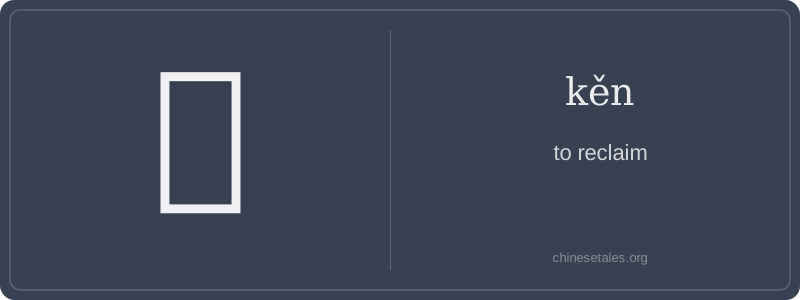
The earliest form of 垦 appears on bronze inscriptions from the Western Zhou (c. 1046–771 BCE) — not as a pictograph, but as a compound ideograph: top part was 氐 (dǐ), a variant of 低 meaning ‘low, pressing down’, and bottom was 土 (tǔ, ‘earth’). Over time, 氐 evolved into the modern top component 肎 (kěn), stylized to resemble a person bending low with effort over soil. By the Qin small seal script, the shape had stabilized: the upper part suggesting exertion, the lower part unmistakably 土 — literally ‘pressing earth downward’ to break its resistance. Its nine strokes aren’t arbitrary: the first three trace the bent posture; the last six build the grounded, stable earth.
This visual logic shaped its semantic evolution. Early texts like the Zuo Zhuan used 垦 to describe states forcibly opening up borderlands — not just digging, but asserting sovereignty through labor. By the Han dynasty, it became synonymous with frontier settlement, appearing in edicts rewarding soldiers who ‘垦边’ (kěn biān, ‘reclaim border lands’). The character never drifted into metaphorical use (unlike 开, which means ‘open’ in dozens of abstract senses); its meaning stayed fiercely literal and physical — a testament to how deeply Chinese thought ties human agency to the tangible act of transforming earth.
At its heart, 垦 (kěn) isn’t just ‘to reclaim land’ — it’s the verb of human will meeting wilderness. It evokes sweat, stubbornness, and hope: turning barren hills, marshes, or desert fringes into fields that feed families. In Chinese, it carries quiet dignity — never used for casual gardening, but for large-scale, socially significant land transformation. You’ll hear it in official speeches about frontier development or historical novels describing Han dynasty settlers pushing westward.
Grammatically, 垦 is almost always transitive and formal — it takes a direct object (垦荒 kěn huāng, ‘reclaim wasteland’) and rarely appears alone. Learners sometimes mistakenly use it like 耕 (gēng, ‘to plow’) or 开垦 (kāi kěn) as interchangeable verbs; but 垦 alone is literary and stilted — you’d say 开垦荒地, not *垦荒地. Also, it never means ‘to cultivate existing farmland’ — that’s 耕 or 种. Confusing the two makes your sentence sound like you’re trying to ‘reclaim’ your own backyard.
Culturally, 垦 reflects China’s deep agrarian ethos and centuries-long struggle against geographical limits. The Great Northern Wilderness reclamation project (1950s–70s), where hundreds of thousands of youth were sent to turn Heilongjiang swamps into grain baskets, cemented 垦 as a symbol of collective sacrifice and state-led progress. Today, it appears mostly in historical, ecological, or policy contexts — never in daily chat. Mistaking it for a casual farming term reveals a subtle but telling gap in cultural register awareness.