墀
Character Story & Explanation
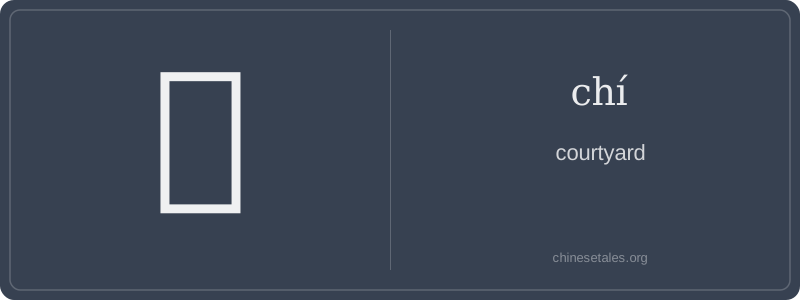
The earliest form of 墀 appears in bronze inscriptions of the Western Zhou dynasty (c. 1046–771 BCE), where it was written as a combination of 土 (tǔ, 'earth/soil') and 甚 (shèn, 'extreme, very') — not as a pictograph of a courtyard, but as a phonetic-semantic compound. The 土 radical anchors it to the ground, while 甚 provided the sound and subtly implied 'profoundly level' or 'intensely paved.' Over centuries, the 甚 component evolved: its top strokes simplified into 幾 (jī), then further stylized into the modern 台-like upper part (⿱丷厶), while the lower half retained its earthen base — giving us today’s 15-stroke structure: a dignified, symmetrical character that visually echoes the orderly paving stones it describes.
By the Han dynasty, 墀 had crystallized into its classical meaning: the raised, paved terrace before palace halls — specifically the vermilion-painted stone platform where ministers knelt to address the emperor. Ban Gu’s Hanshu (Book of Han) mentions officials ‘standing on the dān chí’ as a mark of imperial favor. The character’s visual balance — heavy at the bottom (土), refined above — mirrors this architectural reality: grounded yet elevated, humble in material (earth/stone) yet majestic in function. Even now, when poets write of ‘stepping onto the yù chí,’ they’re not describing real estate — they’re summoning an entire cosmology of power and propriety.
At first glance, 墀 (chí) means 'courtyard' — but not the cozy backyard you imagine with a barbecue grill. This is the solemn, stone-paved courtyard of imperial palaces and ancient temples: think the vast, echoing expanse before the Hall of Supreme Harmony in Beijing’s Forbidden City. It’s not just space — it’s hierarchy made visible. In classical Chinese, 墀 always appears in elevated, formal contexts; you’ll never see it in casual speech like 'my apartment courtyard.' Its presence signals reverence, ceremony, or historical weight — it’s the kind of word that shows up in poetry about fallen dynasties or official documents describing palace architecture.
Grammatically, 墀 is almost never used alone. It only appears in compounds like 丹墀 (dān chí, 'vermilion courtyard') or 玉墀 (yù chí, 'jade courtyard'), both poetic terms for the emperor’s ceremonial platform. Learners sometimes mistakenly treat it like a generic word for 'yard' (like 院子 yuànzi) and try to say *wǒ jiā de chí* — but that would sound like saying 'my home’s imperial terrace' to a native speaker! It’s a fossilized literary term — elegant, precise, and utterly out of place in daily life.
Culturally, 墀 reveals how deeply Chinese spatial thinking ties physical layout to moral order. The courtyard wasn’t just open ground — it was a stage for ritual, a threshold between human and heavenly authority. Even today, when writers use 墀, they’re invoking that layered resonance: silence, scale, solemnity. Mistaking it for a common noun is like calling Westminster Abbey’s nave 'the church floor' — technically true, but missing all the gravity.