塃
Character Story & Explanation
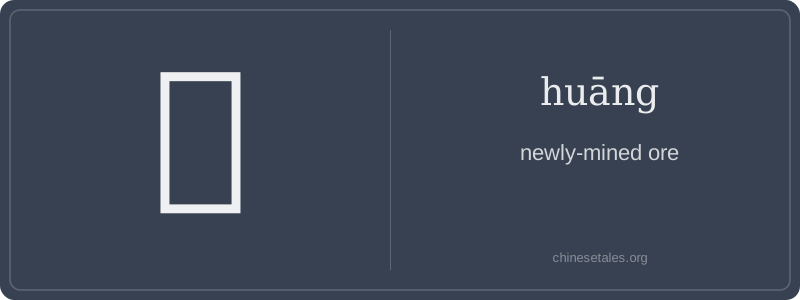
The earliest form of 塃 appears in late Warring States bronze inscriptions as a compound pictograph: on the left, a simplified 土 (tǔ, 'earth/soil') radical, and on the right, a stylized depiction of a miner’s pickaxe striking rock — not just any tool, but one with a curved, hooked tip designed to pry open fissures. Over centuries, the pickaxe evolved: the hook became three angular strokes (the top three strokes of the modern right-hand side), while the handle condensed into a single vertical stroke beneath them. By the Han dynasty clerical script, the shape had stabilized into today’s structure: 土 + 荒 — though crucially, the right component is *not* the common character 荒 (huāng, 'wild'), but a distinct, archaic variant sharing only phonetic resemblance.
This visual origin explains why 塃 never meant 'wildness' — unlike 荒, which depicts weeds choking fields, 塃’s right side was always about *breaking ground*. In the 3rd-century BCE text *Kao Gong Ji* (Records of the Artificers), 塃 appears in metallurgical instructions specifying 'ore extracted before sunset on the day of excavation' — emphasizing temporal immediacy, not ecological state. Its rarity today isn’t due to obsolescence, but specialization: when China industrialized, standardized terms like 原矿 (yuán kuàng) replaced poetic, process-specific words like 塃. Yet in Qing-dynasty mining edicts, officials punished 'selling 塃 before official assay' — proof this character once carried legal weight as the *exact instant* ore entered human commerce.
Think of 塃 (huāng) as the Chinese equivalent of 'virgin ore' — not in the geological textbook sense, but in the visceral, almost mythic way a blacksmith might whisper it over freshly cracked quartz: raw, untamed, and radiating latent power. Unlike common mining terms like 矿 (kuàng, 'ore' in general) or 金 (jīn, 'metal'), 塃 specifically evokes the *first moment* ore emerges from earth — unrefined, untested, still holding the breath of the mountain. It’s rare in modern speech, appearing mostly in technical metallurgical texts or poetic classical allusions to primordial abundance.
Grammatically, 塃 functions almost exclusively as a noun, often paired with classifiers like 块 (kuài) or 份 (fèn), and rarely appears without modifiers: 新塃 (xīn huāng, 'newly mined ore'), 原塃 (yuán huāng, 'raw ore'). You’ll almost never see it alone in a sentence — it’s a specialist term, like 'billet' or 'ingot' in English metalworking jargon. Learners mistakenly treat it like a generic synonym for 'ore', but using 塃 where 矿 is expected sounds like calling a smartphone 'a freshly quarried silicon wafer' — technically true, but hilariously out of register.
Culturally, 塃 carries faint echoes of Daoist reverence for uncarved wholeness (璞, pú — 'unpolished jade') — it’s ore before human intention intervenes. Mistake it for 矿, and you lose that nuance; mistake its tone (huāng, not huǎng or huàng), and you risk saying 'wild' or 'vast' instead. It’s a quiet character, but one that demands respect for precision — like a master smelter tapping his crucible once to hear the true ring of the melt.