坒
Character Story & Explanation
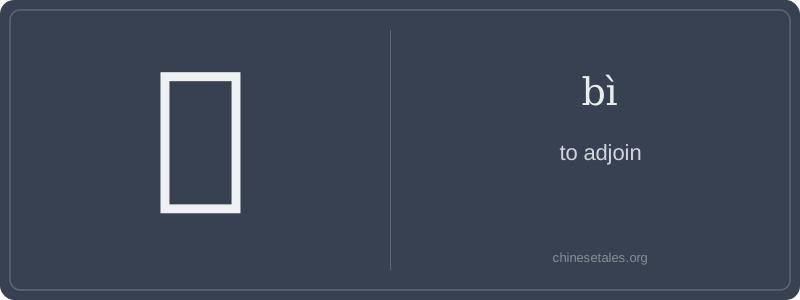
The earliest form of 坒 appears in Warring States bamboo slips as a simple yet elegant composition: a horizontal line (—) representing flat earth, topped by two short, parallel strokes (like 'II'), suggesting adjacent plots or boundaries drawn side-by-side. Over time, the top evolved into the distinctive '比' shape — two people facing each other, symbolizing mutual proximity — while the '土' radical anchored it to the ground. By the Han dynasty seal script, the two '匕' forms had standardized into the mirrored '比' we see today, still clearly echoing 'two things placed next to each other on the earth'.
This visual logic directly shaped its meaning: from 'land plots laid side-by-side' to 'territories in direct contact'. In the Shuōwén Jiězì (121 CE), Xu Shen defined it as 'two lands sharing a border; mutually close', citing its use in regional gazetteers describing frontier counties. Even in Tang poetry, it occasionally surfaces in landscape couplets — 'mountain 坒 cloud' (山坒云) — not to mean 'mountain touches cloud', but 'mountain and cloud exist in seamless, intimate adjacency', a subtle aesthetic of coexistence rarely captured by any other character.
Imagine standing on a quiet hilltop at dusk, watching two fields — one golden wheat, one deep green soy — meet seamlessly at a soft, curving boundary. That’s the *feel* of 坒 (bì): not a hard line like a wall or fence, but a gentle, natural adjacency — land touching land, territory brushing against territory. It carries a quiet, almost poetic sense of proximity without intrusion, evoking harmony and shared borders rather than division.
Grammatically, 坒 is almost exclusively literary and formal — you won’t hear it in daily chat or HSK textbooks. It functions as a verb meaning 'to adjoin' or 'to border', typically in classical-style phrases or geographic descriptions: 'the village 坒 the river' (村坒河), where it often appears after the subject and before the object, with no object marker. Unlike common verbs like 靠 (kào) or 邻 (lín), 坒 implies mutual, reciprocal contact — both sides are equally active in the adjoining. Learners sometimes misread it as a variant of 壁 (bì, 'wall') or 壁 (same pinyin), but that’s a classic trap: 坒 has no connotation of barrier — quite the opposite!
Culturally, 坒 echoes ancient Chinese land surveying and territorial consciousness — think Zhou dynasty boundary markers carved into stone, or Song-era maps noting 'this county 坒 that prefecture'. Its rarity today makes it a subtle signal of refined diction: spotting it in a modern essay or official document hints at deliberate stylistic elegance. Don’t force it into speech — but savor it like a rare tea leaf when you encounter it in writing.