坋
Character Story & Explanation
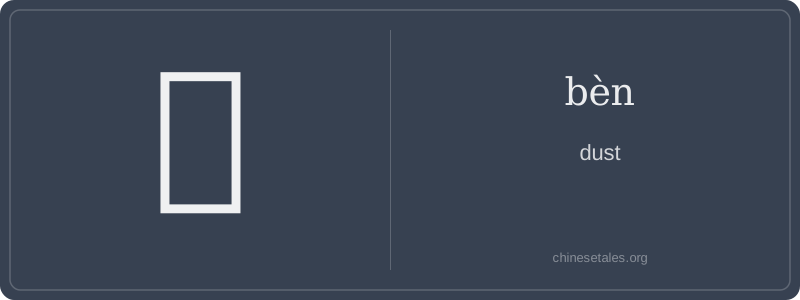
The earliest form of 坋 appears in bronze inscriptions as a pictograph showing two parallel horizontal strokes (representing ground or earth) beneath a cluster of scattered dots — visual shorthand for particles suspended in air above soil. Over centuries, the dots evolved into the top component resembling ‘分’ (fēn, ‘to divide’), while the lower ‘土’ (tǔ, ‘earth’) remained anchoring the meaning in the ground. By the Han dynasty seal script, the upper part had stylized into what we now write as ‘分’, though it bears no etymological relation to the verb ‘to divide’ — it’s purely phonetic and visual residue of those ancient floating dots.
This character was used in early texts like the Chǔ Cí (Songs of Chu) to evoke desolation — ‘the road vanished in 坋’ meant utter abandonment, where even dust obscured the path. Unlike 尘, which later absorbed broader semantic roles (including metaphorical uses like ‘mortal world’), 坋 stayed stubbornly literal and physical. Its visual heaviness — the dense ‘分’ overhead pressing down on ‘土’ — mirrors its semantic weight: dust as burden, as residue, as the inescapable trace of decay. No wonder it faded: language preferred lighter, more flexible words — and 尘 floated away with them.
Let’s be honest: 坋 (bèn) is a ghost character — it’s real, documented in classical dictionaries like the Shuōwén Jiězì, but it’s virtually extinct in modern spoken and written Chinese. Its core meaning is ‘dust’ — not the poetic ‘dust of time’, not the scientific ‘particulate matter’, but coarse, gritty, earthy dust kicked up by hooves or wind: think dry loess plains of northwestern China after a drought. It carries a tactile, almost gritty weight — you can *feel* the particles in your throat when you say bèn.
Grammatically, 坋 functions only as a noun and appears almost exclusively in fixed literary or archaic compounds (like 坋坋 or 坋埃), never standalone in speech or contemporary writing. You’ll never hear ‘this table is full of 坋’ — that’s always 灰 (huī) or 尘 (chén). Learners sometimes mistakenly insert 坋 into sentences expecting ‘dust’ — a classic fossil-word trap. It’s like using ‘whence’ instead of ‘where’ in English: technically correct, historically grounded, and utterly out of place at the coffee shop.
Culturally, 坋 evokes early agrarian China — the dust of tilled fields, of caravan routes, of ancestral tombs swept by desert winds. It’s the dust that clings to ritual bronze vessels, not the dust on your laptop. Modern learners rarely encounter it outside paleography classes or classical poetry annotations. The biggest mistake? Confusing it with 尘 (chén), which *is* the living, breathing word for ‘dust’ — and looks nothing like 坋. Remember: if you need ‘dust’ today, reach for 尘. 坋 is for reading Tang dynasty tomb inscriptions — or impressing your calligraphy teacher.