坆
Character Story & Explanation
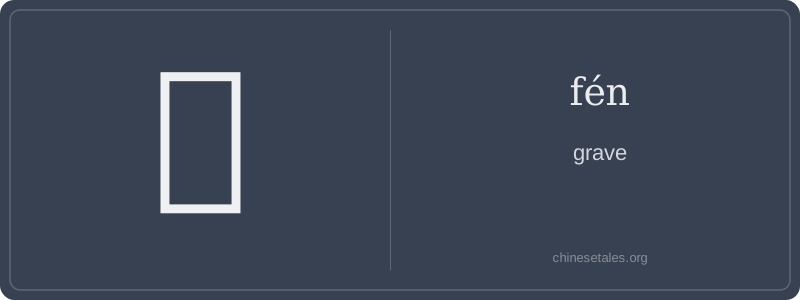
The earliest form of 坆 appears in bronze inscriptions of the Western Zhou dynasty (c. 1046–771 BCE) as a simple yet evocative pictograph: two parallel horizontal lines (representing the earth’s surface) with a small, centered mound rising between them — like a gentle hill marked on flat ground. Over centuries, the mound evolved into the top component 土 (tǔ, ‘earth’), while the lower part solidified into 文 (wén, originally a stylized pattern or inscription), likely indicating the carved epitaph or ritual marker placed atop the mound. By the Han dynasty, the structure was standardized as 土 + 文 — a visual contract between soil and commemoration.
This evolution mirrors its semantic journey: from a concrete landform to a cultural institution. In the *Zuo Zhuan*, it appears in descriptions of aristocratic burials where mound height reflected rank — a literal elevation of status beyond death. Later, in Tang funerary steles, 坆 conveys solemnity without sorrow; it’s not about loss, but about enduring lineage. The character’s quiet symmetry — earth above text — captures a core Confucian idea: remembrance is an act of cultivation, not lamentation.
Here’s the truth no textbook tells you: 坆 (fén) isn’t just ‘grave’ — it’s a word soaked in reverence, silence, and layered social meaning. In classical Chinese, it specifically denotes a *raised earthen mound* marking a burial site — not just any grave, but one that’s visible, tended, and ritually significant. That elevation matters: it signals respect, ancestral continuity, and the enduring presence of the deceased in family memory. You’ll rarely hear it in casual speech today; it lives in literary, historical, or ceremonial contexts — think inscriptions on tombstones, classical poetry, or formal mourning documents.
Grammatically, 坆 functions almost exclusively as a noun and appears in fixed compounds (like 坟墓 or 冢坟), never as a verb or modifier on its own. Learners sometimes try to use it like English ‘grave’ — e.g., *‘I visited his fén’* — but that sounds jarringly archaic or poetic in modern Mandarin. Instead, people say 陵 (líng) for imperial tombs, 墓 (mù) for general graves, or even just 墓地 (mùdì, ‘cemetery’) in everyday talk. 坆 stands apart: solemn, unadorned, and quietly authoritative.
Culturally, its rarity is the point. Its near-absence from spoken language reflects how Chinese tradition handles death: with restraint, indirectness, and deep-rooted ritual precision. A common mistake? Confusing it with 墓 (mù) — which is neutral and widely used — or misreading its tone (fén, not fēn or fěn). And yes, it *can* be read méi in ultra-rare, dialectal or phonetic-variant contexts (e.g., ancient rhyming dictionaries), but that pronunciation is functionally extinct outside scholarly reconstructions — ignore it unless you’re transcribing Tang dynasty poetry aloud.