嚓
Character Story & Explanation
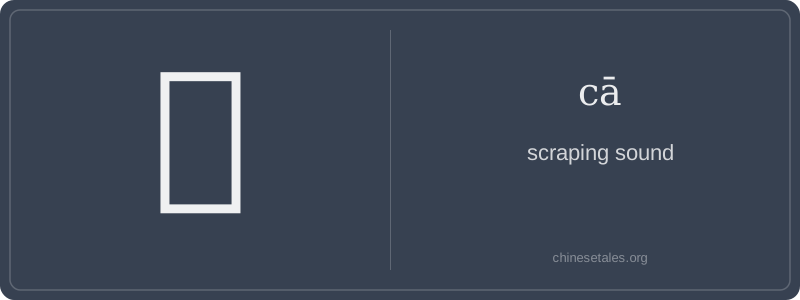
The earliest trace of 嚓 appears not in oracle bones but in late clerical script (Lìshū) around the Han dynasty, where it emerges as a deliberate phonosemantic compound. Its left side, 口 (kǒu), is the universal 'sound' radical — anchoring it firmly in the realm of vocalization and noise. The right side, 察 (chá), was borrowed primarily for its sound (cā/chā) but also carries semantic weight: 察 means 'to observe closely' or 'to scrutinize'. So visually, 嚓 was conceived as 'a sound so distinct you must *scrutinize* it' — a brilliant fusion of ear and eye. Over centuries, strokes standardized: the top of 察 simplified from 祭’s complex structure to today’s two horizontal lines and a dot, while the 口 retained its clean, enclosing shape — 17 strokes total, each contributing to its crisp, staccato feel.
This character didn’t appear in early classics like the Shījīng or Lún Yǔ; it’s a later linguistic innovation born from vernacular storytelling and performance — think Ming-Qing vernacular novels or Peking opera stage directions, where vivid sound effects were essential for immersion. In works like *Jīn Píng Méi*, onomatopoeic clusters like 咔嚓、噼嚓 intensified dramatic tension during confrontations or sudden breaks. Crucially, the visual weight of 察 (14 strokes!) combined with 口 (3) creates a sense of *deliberate attention* — unlike fleeting sounds like 啪 (pā), 嚓 demands your focus, like a sonic fingerprint of friction.
Think of 嚓 (cā) as Chinese onomatopoeia’s gritty cousin — not a gentle 'click' or soft 'hiss', but the sharp, dry, slightly abrasive sound of something scraping: a chair leg dragged across floorboards, a knife scraping rust off metal, or even fingernails skittering down a chalkboard. It’s purely auditory and visceral, carrying texture and friction in its very pronunciation — that raspy, voiceless 'c-' followed by a clipped 'ā' mimics the sudden stop of motion against resistance.
Grammatically, 嚓 is almost always used reduplicatively (嚓嚓 cā cā) or paired with other sound characters (e.g., 咔嚓 kā cā), functioning as an adverbial phrase or standalone interjection. You’ll rarely see it alone in formal writing; instead, it appears mid-sentence to punctuate action: '他嚓嚓几下就把锈刮掉了' — note how the reduplication implies repetition and rhythm. Learners often mistakenly treat it like a verb ('to scrape') — but 嚓 has no grammatical function beyond evoking sound; it never takes objects or complements.
Culturally, 嚓 belongs to a rich tradition of Chinese sound-imitating characters where visual form reinforces acoustic quality: the 口 radical signals 'mouth/sound', while the right side (察) hints at keen perception — you don’t just hear the scrape, you *notice* it sharply. A common pitfall? Confusing it with 擦 (cā, 'to wipe'), which shares the pinyin but is semantically unrelated and visually distinct. Also, though 嚓 can be pronounced chā in rare literary or dialectal contexts (e.g., in older poetry for rhythmic variation), cā is the only pronunciation learners need — and the one used in all modern spoken and written onomatopoeic usage.