嚃
Character Story & Explanation
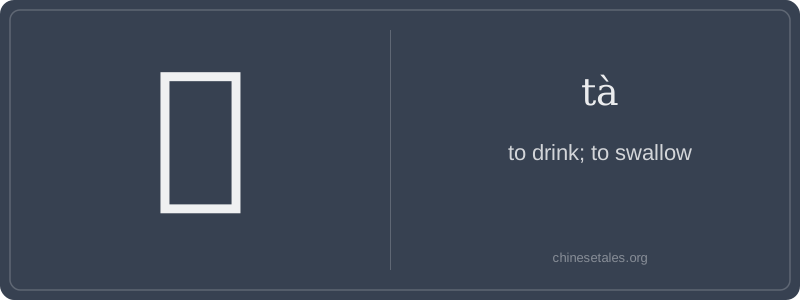
The earliest form of 嚃 appears not in oracle bones but in late Warring States bamboo slips and Han dynasty texts — and it’s a masterclass in phonosemantic fusion. Its left side 口 (kǒu, ‘mouth’) is the semantic clue, anchoring it firmly in oral action. The right side 舐 (shì, ‘to lick’) was later simplified into 㚇 (a rare variant of 舐) — but crucially, this component wasn’t chosen for meaning alone. Its ancient pronunciation rhymed closely with tà, making it a *phonetic loan* that also subtly reinforced the tongue-in-mouth motion of licking → swallowing → gulping. Over centuries, strokes streamlined: the complex 舐 became stylized into today’s three horizontal lines atop a slanted hook — a visual echo of the tongue flicking back as you swallow.
This character’s meaning didn’t drift — it *deepened*. In the Shuōwén Jiězì (121 CE), Xu Shen defined it as ‘to drink deeply, with sound’, citing its use in descriptions of warriors quenching thirst mid-battle or scholars sipping wine while composing verse. By the Tang dynasty, poets like Li Bai used 嚃 to heighten sensory immediacy — e.g., ‘嚃尽千杯月’ (gulping down a thousand cups beneath the moon), where the verb’s harsh, percussive tone mirrors the clink of bronze cups and the burn of strong wine.
Here’s the truth no textbook tells you: 嚃 (tà) isn’t just ‘to drink’ — it’s the *sound* of swallowing, the visceral gulp that echoes in your throat. It’s onomatopoeic at its core, born from the guttural ‘tā’ or ‘tà’ noise made when liquid or food slides down. Unlike common verbs like 喝 (hē) — polite, neutral, and HSK-friendly — 嚃 is raw, literary, and slightly archaic. You’ll rarely hear it in daily conversation, but you’ll see it in classical poetry, historical novels, or vivid descriptive prose where the writer wants you to *feel* the physical act — not just observe it.
Grammatically, it behaves like a transitive verb (e.g., 嚃一口酒 — ‘gulp down a mouthful of wine’), but it almost never stands alone as a main verb in modern spoken Chinese. Learners often mistakenly use it like 喝, expecting it to work in casual sentences like ‘I drink tea every morning.’ Nope — that would sound like quoting a Ming dynasty opera. Instead, it appears in tightly packed literary phrases, frequently with measure words like 口 (kǒu) or 饮 (yǐn), and often carries connotations of haste, thirst, exhaustion, or even desperation.
Culturally, 嚃 hints at how Chinese writing captures embodied experience — not just action, but *sensation*. A common mistake? Confusing it with 吞 (tūn, ‘to swallow’) — but 吞 is about the act; 嚃 is about the *sound-and-feel* of it. Also, beware tone: tà (4th) is distinct from tā (1st), which means ‘he/she/it’. Mispronouncing it flattens the whole sensory texture — like serving espresso without the crema.