噼
Character Story & Explanation
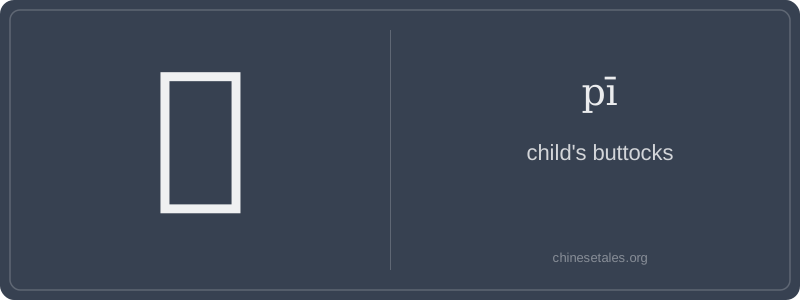
The earliest trace of 噼 appears not in oracle bones but in late Ming–Qing vernacular manuscripts and folk primers, where it emerges as a deliberately constructed 'sound-plus-sign' character. Visually, it fuses 口 (kǒu, 'mouth') — signaling vocalization — with 比 (bǐ, 'to compare') below, but crucially *not* the standard 比: the two 'l' shapes are tilted inward, evoking cupped hands cradling a rounded shape, and the final stroke curls like a tiny dimple. Over centuries, clerks simplified the top 口 into a tighter square and exaggerated the downward sweep of the lower component to suggest softness — turning abstract strokes into a visual wink at baby fat.
This character was born from oral culture, not classical texts — you won’t find it in the *Shuōwén Jiězì* or Tang poetry. Instead, it thrived in Qing-era nursery rhymes and regional opera interludes, where actors would tap their own bottoms and chirp 'pī!' to cue laughter. The mouth radical anchors it in speech-as-action: it’s less a label and more a *sound made while pointing*, like a parent going 'pī-pī!' while tickling. Its meaning never broadened — unlike similar-sounding characters, it resisted formalization, staying stubbornly domestic, tactile, and tenderly absurd.
Let’s get one thing straight: 噼 (pī) is *not* a standard, polite term — it’s a folksy, almost onomatopoeic baby-talk word for a toddler’s bottom. Think of it as the Chinese linguistic equivalent of saying 'tushie' or 'bun-bun' in English: affectionate, slightly silly, and strictly reserved for very young children or intimate, playful contexts. It carries zero clinical or formal weight — you’ll never see it in medical textbooks or official documents. Its core feel is soft, round, dimpled, and gently humorous — like the word itself has chubby cheeks.
Grammatically, 噼 functions almost exclusively as a noun, usually with diminutive or possessive modifiers: 小噼 (xiǎo pī), 我家噼 (wǒ jiā pī), or even reduplicated as 噼噼 (pī pī) for extra cuteness. It rarely takes adjectives directly — instead, speakers rely on context and tone: '宝宝噼红红的' (bǎo bǎo pī hóng hong de) — 'Baby’s bottom is rosy' — works because the whole phrase breathes nursery warmth. Crucially, it’s *not* used for adults, teens, or even older kids — crossing that line sounds absurd or infantilizing.
Culturally, this character reveals how Chinese handles taboo-adjacent body parts through phonetic play and visual softening. Learners often mistakenly assume it’s related to the common character 屁 (pì, 'fart') due to sound similarity — but that’s a dangerous mix-up: 屁 is neutral-to-rude, while 噼 is tender-to-teasing. Also, its radical 口 (mouth) isn’t about speech here — it signals 'uttered sound', reflecting how the word entered language as a cooed, mouth-shaped syllable rather than a descriptive term. That’s why it’s absent from HSK: it lives in lullabies, diaper changes, and grandma’s scolding — not grammar drills.