噀
Character Story & Explanation
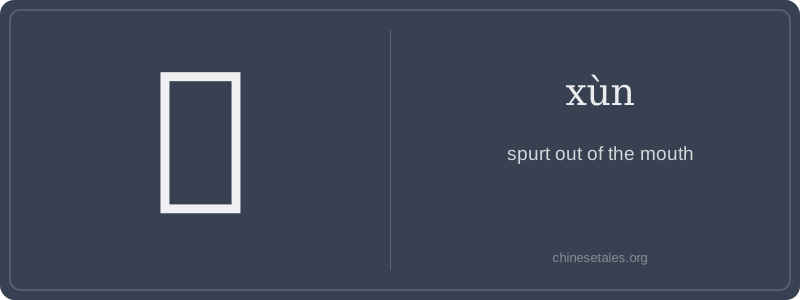
The earliest form of 噀 appears in seal script (c. 3rd century BCE), where it fused two powerful elements: 口 (kǒu, 'mouth') on the left — clearly depicted as a square opening — and 迅 (xùn, 'swift') on the right, itself composed of 辵 (chuò, 'walking') + 旬 (xún, 'ten days', here acting phonetically). Crucially, 迅 wasn’t just borrowed for sound — its meaning 'lightning-fast' was deliberately recruited. The original pictograph didn’t show liquid; it showed *motion erupting from an orifice*, with strokes mimicking outward-radiating sprays — three short diagonal dashes emerging from the mouth’s corner in later clerical script.
This visual logic held across millennia: the mouth emits something *with speed and force*. In the Shuōwén Jiězì (121 CE), Xu Shen defined it as 'to expel violently from the mouth' — citing its use in describing battlefield wounds where blood erupted under arterial pressure. By the Tang dynasty, poets used it metaphorically: Li He wrote of ghosts 噀冷雾 ('spurting cold mist'), linking breath, spirit, and sudden manifestation. Even today, the character’s sharp, angular right side (迅) still vibrates with that ancient sense of urgent propulsion.
Think of 噀 (xùn) as Chinese’s answer to the dramatic ‘spit-take’ — that explosive, involuntary spray of liquid from the mouth when you’re shocked or disgusted. It’s not just ‘spit’; it’s forceful, sudden, and often emotional: a burst, a gush, a jet — like a tiny internal firehose triggered by surprise, anger, or nausea. Unlike generic verbs like 吐 (tǔ, 'to vomit/spit'), 噀 emphasizes *directionality* and *velocity*: the liquid shoots *out*, usually forward and visibly.
Grammatically, it’s almost always used as a transitive verb with a clear object (e.g., 噀血, 噀唾), and rarely stands alone. You’ll see it in literary or medical contexts — never in casual chat ('I spurted coffee' sounds absurd in English, and so does 我噀了 in Mandarin). It’s also frequently reduplicated for intensity: 噀噀地, evoking rhythmic, repeated spurting — like a malfunctioning soda can.
Culturally, this character carries visceral, almost theatrical weight. Classical texts use it to underscore moral revulsion (e.g., spitting blood after hearing treachery), while modern medical writing uses it clinically for hemorrhage. Learners often misread it as xūn (like 熏) or overuse it like 吐 — but 噀 implies *pressure*, *precision*, and *sudden release*. If 吐 is a sigh, 噀 is a gunshot.