啯
Character Story & Explanation
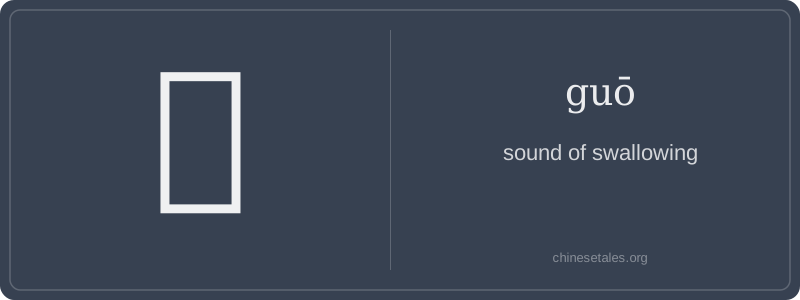
The character 啯 has no ancient oracle bone or bronze script form — it’s a latecomer, born during the Ming–Qing transition as vernacular fiction exploded. Its shape is brilliantly functional: the left side 口 (kǒu, ‘mouth’) anchors it as a speech/sound character, while the right side 戈 (gē, ‘dagger-axe’) isn’t literal weaponry — it’s phonetic, approximating the *guō* sound. But here’s the visual joke: 戈’s sharp, downward stroke mimics the throat’s sudden constriction during swallowing — a graphic wink at physiology. No ancient scribe carved this; a Ming storyteller scribbled it to make readers *hear* the gulp mid-sentence.
By the time of *Dream of the Red Chamber* and later Qing novels, 啯 appears in marginalia and dialogue tags to punctuate rustic or unrefined speech — distinguishing a coarse laborer’s swallow from a scholar’s silent sip. It never entered classical lexicons, yet persisted through oral performance traditions: storytellers would shout ‘Guō!’ with a throaty click to signal a character downing liquor, and audiences knew *exactly* what throat muscles were flexing. Its survival isn’t due to prestige — it’s because Chinese writing, at its liveliest, refuses to ignore the wet, noisy truth of being human.
Think of 啯 not as a word you’ll find in textbooks or flashcards, but as a sonic cameo — a tiny onomatopoeic actor that bursts onto the page only when someone swallows loudly. Its meaning is visceral and immediate: the abrupt, moist, slightly guttural guō sound your throat makes after a gulp of water, a shot of baijiu, or even just nervous saliva. It’s not abstract — it’s bodily, almost comical in its honesty. You won’t see it in formal writing or exams (hence its absence from HSK), but it thrives in dialogue-rich fiction, comic strips, and spoken storytelling.
Grammatically, 啯 is almost always used as an interjection or standalone sound-effect particle — never as a verb or noun on its own. It rarely carries grammatical weight, but it adds crucial texture: ‘He nodded, guō, and downed the liquor.’ In sentences, it’s typically set off by commas or em dashes, sometimes doubled (啯啯) for rhythm or emphasis. Learners often mistakenly try to use it like a verb (e.g., *‘he guō-ed’*), but 啯 doesn’t conjugate — it *is* the sound, frozen in ink.
Culturally, 啯 carries subtle class and context cues: it’s more common in depictions of working-class men, rural settings, or moments of raw physicality — think farmers after a long day, soldiers sharing rice wine, or cartoon characters reacting to spicy food. Overusing it can unintentionally stereotype; underusing it misses a layer of authentic oral flavor. And yes — native speakers *do* recognize this character instantly, even if they’ve never studied it. It just *feels* right — like hearing your own throat echo back at you.