嘐
Character Story & Explanation
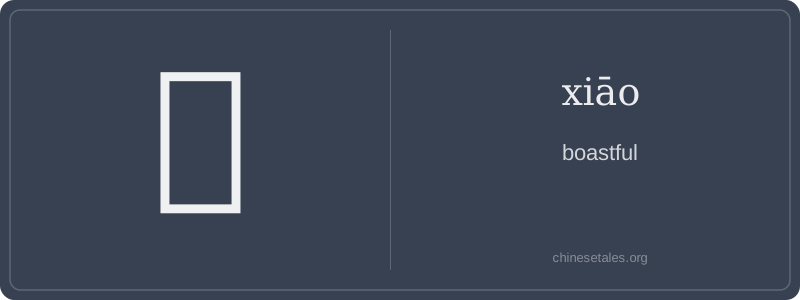
The character 嘐 first appeared in seal script (around 3rd century BCE), not oracle bone — and its origin is delightfully literal. Its left side 口 (kǒu, ‘mouth’) is obvious, but the right side is 尧 (yáo), an ancient phonetic component meaning ‘lofty, eminent’. In early forms, 尧 depicted a person with exaggeratedly tall headgear and raised arms — symbolizing lofty status or pretension. So 嘐 literally ‘mouth + loftiness’ = speech inflated by false self-importance. Over time, clerical and regular script streamlined the strokes, but the visual metaphor held: a mouth projecting something unnaturally high and hollow.
Its meaning crystallized in the Warring States period, appearing prominently in the Mencius (3A:2), where Mencius contrasts true moral cultivation with superficial posturing: ‘Those who practice virtue without sincerity are like those who say “I am virtuous” — they are 嘐嘐然.’ Here, 嘐嘐 isn’t just boasting — it’s the *sound* of hollow moral performance. Later, Song dynasty scholars like Zhu Xi used 嘐嘐 to critique pedants who recited classics without understanding. The character thus evolved from describing vocal tone to embodying an entire epistemological flaw: confidence untethered from substance.
First, let’s be honest: 嘐 (xiāo) is a linguistic ghost — rare, poetic, and dripping with classical disdain. It doesn’t mean ‘boastful’ in the casual, modern sense like 吹牛 (chuī niú, 'to blow ox' = to brag). Instead, it evokes *performative arrogance*: someone puffing up their chest, voice booming, words swelling beyond truth — like a rooster crowing at dawn just to hear itself. The feeling is visceral, almost onomatopoeic: that sharp, strident ‘xiāo’ sound mimics the shrill, self-important tone of empty grandstanding.
Grammatically, 嘐 is almost never used alone. It appears almost exclusively in the fixed classical compound 嘐嘐 (xiāo xiāo), functioning as an adverbial reduplication meaning ‘in a boastfully self-satisfied way’ — always modifying verbs or adjectives. You’ll see it in phrases like 嘐嘐自得 (xiāo xiāo zì dé, ‘smugly self-satisfied’) or 嘐嘐然 (xiāo xiāo rán, ‘in a haughtily confident manner’). Crucially, it’s not used predicatively (*He is 嘐* is ungrammatical); it only works inside set expressions.
Culturally, this character reveals how deeply Chinese tradition distrusts ungrounded confidence. Confucius himself criticized ‘empty virtue-performance’ — and 嘐嘐 became the lexical scalpel for that exact flaw. Learners often mistakenly treat it as a standalone adjective (like ‘boastful’ in English), but it’s strictly bound to classical syntax and literary register. Using it in spoken Mandarin would sound like quoting Mencius at a coffee shop — charming, but deeply out of place.