嘅
Character Story & Explanation
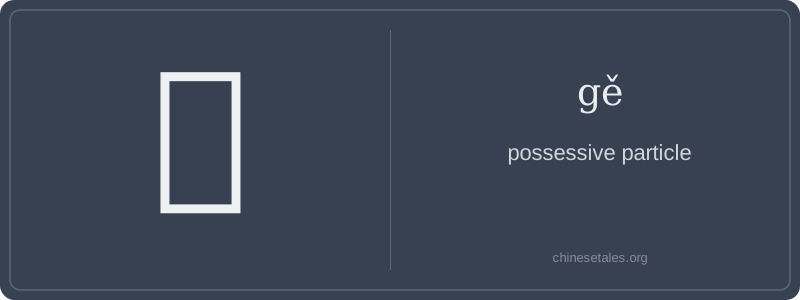
There is no oracle bone or bronze script for 嘅—it’s a latecomer, born in the Southern Song dynasty (12th c.) as a phonetic-semantic compound. Its left side 口 (kǒu, 'mouth') signals pronunciation (early Cantonese had oralized final consonants), while its right side 葛 (gé, 'kudzu vine') was borrowed purely for sound—no botanical meaning intended. Stroke-by-stroke: start with 口 (3 strokes), then write 葛—first 艹 (3 strokes), then 一 (1), then 略 (5 strokes: the 'squiggle' + 'square' + 'dot'). By Ming dynasty texts, it had stabilized into today’s 12-stroke form, its shape mirroring how spoken Cantonese 'clings' to nouns like ivy.
The character emerged not from classical literature but from vernacular song lyrics and opera scripts—where scribes needed a way to capture the soft, clipped possessive 'gě' sound that Mandarin’s 的 couldn’t replicate. Unlike 的, which appears in Tang poetry, 嘅 first appears in 16th-century Cantonese folk ballads, always paired with personal pronouns (我嘅, 你嘅). Its visual reliance on 口 underscores its essence: this particle lives only in speech—not in essays, not in dictionaries, but in the breath between friends saying 'this cup? mine.' It’s written mouth, spoken truth.
Imagine you’re at a Cantonese street market in Mong Kok, haggling over a vintage vinyl record. The vendor holds it up and says, '呢張唱片係我阿爸嘅!' (nī jēung chàahn pàahn haih ngóh ā bāa gě!) — 'This record belongs to my dad!' That little 嘅 at the end? It’s not just grammar—it’s the linguistic glue of Cantonese identity: soft, possessive, deeply relational. Unlike Mandarin’s 的 (de), 嘅 carries a warm, colloquial intimacy—it’s how families claim love, friends claim jokes, and teens claim fandom ('佢係我偶像嘅!').
Grammatically, 嘅 only appears *after* nouns or pronouns to mark possession—never before them, never alone, never in formal writing. You’ll never see '嘅書' (gě shū); it’s always '我嘅書' (ngóh gě syū). And crucially: it’s pronounced gě *only* in this grammatical role—never as gè or gē. Learners often mispronounce it like 'ge' in Mandarin, or worse, confuse it with 的 and try using it in Mandarin speech (a dead giveaway you’ve been binge-watching too much TVB drama).
Culturally, 嘅 is a quiet act of resistance: it survives in Hong Kong, Macau, and overseas Cantonese communities despite decades of Mandarin promotion. Its absence from the HSK list isn’t oversight—it’s a reminder that Chinese isn’t one language, but a constellation. When you use 嘅, you’re not just marking possession—you’re nodding to a living dialectal tradition where tone, rhythm, and mouth-shape (that 口 radical!) matter more than standardized exams.