嗒
Character Story & Explanation
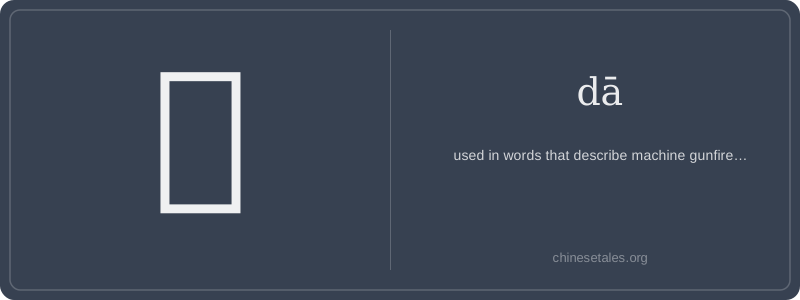
The earliest ancestor of 嗒 isn’t found in oracle bones — it’s a latecomer, born in the Qing dynasty or even early Republican era as Chinese writers began transcribing modern mechanical sounds. Visually, it’s a masterclass in phonosemantic design: the left radical 口 (kǒu, ‘mouth’) signals its domain — speech, sound, vocalization — while the right component 答 (dá, ‘to answer’) provides both pronunciation (dā, a tonal variant of dá) and subtle semantic resonance: an ‘answer’ from a machine — a short, definitive, almost conversational *ping*. Stroke by stroke, it evolved from handwritten shorthand: 口 (3 strokes) + 竹 (bamboo, top of 答) + 合 (to close, bottom of 答) → simplified into today’s clean 12-stroke form where the ‘bamboo’ and ‘mouth’ merge visually into a compact, punchy glyph.
Unlike ancient characters with ritual or agricultural roots, 嗒 emerged from urban modernity — first appearing in early 20th-century fiction describing telegraph clicks, train couplings, and later, machine-gun fire in war novels. It never appears in classical texts (no Confucius, no Du Fu), but it’s all over Mao Dun’s 1930s Shanghai stories and contemporary web fiction describing anime-style gunfights. Its visual shape — compact, angular, mouth-open-and-sharp — mirrors the very sound it represents: a sudden, unvoiced plosive burst. No wonder it feels more like punctuation than a word.
Think of 嗒 not as a word with meaning, but as a sonic fingerprint — a written echo of sharp, percussive sound. It’s not a verb, noun, or adjective in the traditional sense; it’s an onomatopoeic syllable, pure auditory texture frozen in ink. You’ll never find it alone in formal writing or dictionaries as a standalone lexical item — it only lives inside reduplicated forms like 嗒嗒 (dā dā) or compound expressions like 嗒嗒响. Its ‘meaning’ is entirely contextual and sensory: the metallic *clack* of a typewriter key, the staccato *pop-pop* of a misfiring scooter, or the dry, hollow *tick-tock* of an antique clock when you’re lying awake at 3 a.m.
Grammatically, 嗒 behaves like most Chinese onomatopoeias: it rarely stands solo, almost always appears reduplicated (嗒嗒), and frequently pairs with verbs like 响 (to sound), 敲 (to tap), or 想 (to go *‘sound-wise’* — yes, that’s a real usage!). Learners often mistakenly treat it like a verb ('He *dāed* the door') or try to use it without repetition — but native speakers would hear that as incomplete, like saying 'ka' instead of 'ka-ching!' You’ll see it in descriptive narration (e.g., 小雨嗒嗒地打在窗上), never in commands or questions.
Culturally, 嗒 belongs to the rich tradition of Chinese sound-words that prioritize rhythmic authenticity over phonetic precision — think of how English says *tick-tock*, while Mandarin prefers 嗒嗒 for clocks *and* gunfire, letting context do the heavy lifting. A common mistake? Using it for soft sounds (like a whisper or rustle) — 嗒 is inherently sharp, abrupt, and mid-to-high frequency. If it doesn’t make you flinch slightly when you say it out loud, you’re probably misplacing it.