嗉
Character Story & Explanation
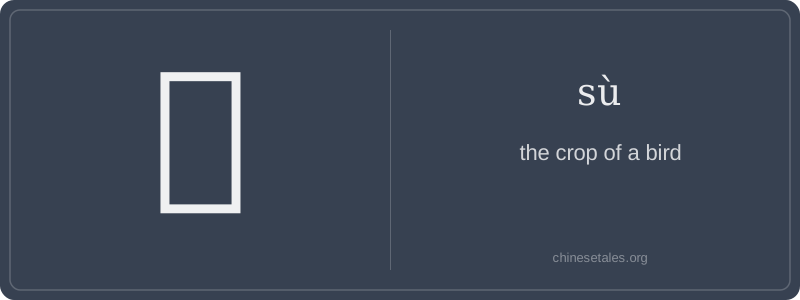
The earliest form of 嗉 appears in seal script (around 200 BCE), where it already combined 口 (kǒu, 'mouth') on the left with 宿 (sù, 'to lodge, dwell overnight') on the right. The 口 radical signals this is a bodily orifice-related term — not just any mouth, but an internal cavity connected to ingestion. The right side 宿 is both phonetic (sharing the sù sound) and semantic: it evokes the idea of *temporary lodging* — exactly what a crop does: holds food briefly before moving it onward. Over centuries, the seal script’s flowing strokes hardened into the modern 13-stroke structure: 口 (3 strokes) + 宿 (10 strokes), with the top 宀 (roof) neatly framing the inner 佰 (bǎi) and 亻 (rén) components like a tiny sheltered chamber.
This semantic-phonetic pairing was deliberate and brilliant: 宿 gave the pronunciation *and* the core idea of ‘holding something temporarily’. In the 13th-century agricultural classic 《农书》 (Nóngshū), 嗉 appears in passages describing how pigeons regurgitate ‘crop milk’ to feed squabs — proving the term wasn’t just anatomical, but functional and nurturing. Even today, the visual layout mirrors its meaning: the ‘mouth’ radical opens leftward, while the ‘lodging’ component curls inward like a pouch — a rare case where the character’s shape *literally* mimics its biological counterpart.
Think of 嗉 (sù) as the bird’s built-in snack pouch — a muscular, expandable chamber in its throat where pigeons, doves, and chickens temporarily store food before digestion. The character feels visceral and anatomical: it’s not poetic or abstract, but grounded in biology and farming life. You’ll almost never see it in daily conversation — it’s a specialist term, like 'gizzard' or 'cloaca' in English — used mainly by veterinarians, ornithologists, farmers, or in classical texts describing animal physiology.
Grammatically, 嗉 functions as a noun and always appears with classifiers (e.g., 一个嗉囊) or in compound words. It rarely stands alone. Learners sometimes mistakenly treat it as a verb ('to crop') — but no, it’s strictly nominal. Also, don’t confuse it with mouth-related verbs like 吐 (tǔ, 'to spit') or 吞 (tūn, 'to swallow'); 嗉 is purely structural — it’s the *place*, not the *action*. You’d say 这只鸽子的嗉囊胀大了 (zhè zhī gē zi de sù náng zhàng dà le), not *嗉大了* — the latter isn’t grammatical.
Culturally, 嗉 appears in ancient agricultural manuals and Ming-Qing veterinary treatises — often paired with 粪 (fèn, manure) or 食 (shí, food) to describe avian digestion. Modern learners rarely encounter it outside zoology textbooks or idioms like 嗉囊饱满 (sù náng bǎo mǎn, 'crop full'), a metaphor for preparation and readiness. A common mistake? Using it in place of 胃 (wèi, stomach) — but birds’ crops are *not* stomachs; they’re pre-stomach storage sacs, evolutionarily distinct and functionally unique.